Discover METAhybrid Thermal Insulated Roofing Sheet India in India by Geometric Steels. Cut HVAC loads up to by 35% with Class O fire-rated, ECBC-compliant systems.
The Hidden Cost of Non-Insulated Factory Roofing in India
A 10,000 sqm industrial shed with a standard single-skin metal roofing sheet conducts heat at approximately 45–55 W/m²K during peak summer hours. At Maharashtra’s typical June ambient temperature of 42°C, your roof is not just covering your building — it is actively heating it from above while your HVAC system fights from below.
The numbers are unambiguous. An industrial cooling system working against a bare metal roof consumes 35–45% more energy than the same system operating under a properly insulated roof with a verified R-value. For a 10,000 sqm warehouse running 10 hours of HVAC per day at an average cooling load of 150 TR (tons of refrigeration):
| Cost Scenario | Standard Single-Skin Roof | METAhybrid Insulated Roof |
| HVAC load (TR) — 10,000 sqm | 150 TR (peak summer) | 95–105 TR (Up to 30–37% reduction) |
| Power consumption per day | ~1,800 kWh/day | ~1,140–1,260 kWh/day |
| Electricity cost/day (@ ₹8/unit) | ₹14,400/day | ₹9,120–₹10,080/day |
| Annual saving (240 operating days) | — | ₹1.2L – ₹12.7L per year |
| Payback period on METAhybrid upgrade | — | Typically 2.5–5 years |
METAhybrid is the only insulated metal roofing profile system in India verified to a published R-value with Class O fire rating. It is not a cosmetic product upgrade — it is a capital expenditure with a measurable return.
This blog explains the engineering behind METAhybrid, what the applicable IS standards and green building rating systems require, how it compares to PUF sandwich panels and standard metal sheets, and why it is becoming the default specification for temperature-controlled industrial buildings, cold chain logistics facilities, and commercial construction projects pursuing GRIHA or LEED ratings.
What Is METAhybrid? The Engineering Inside the Profile
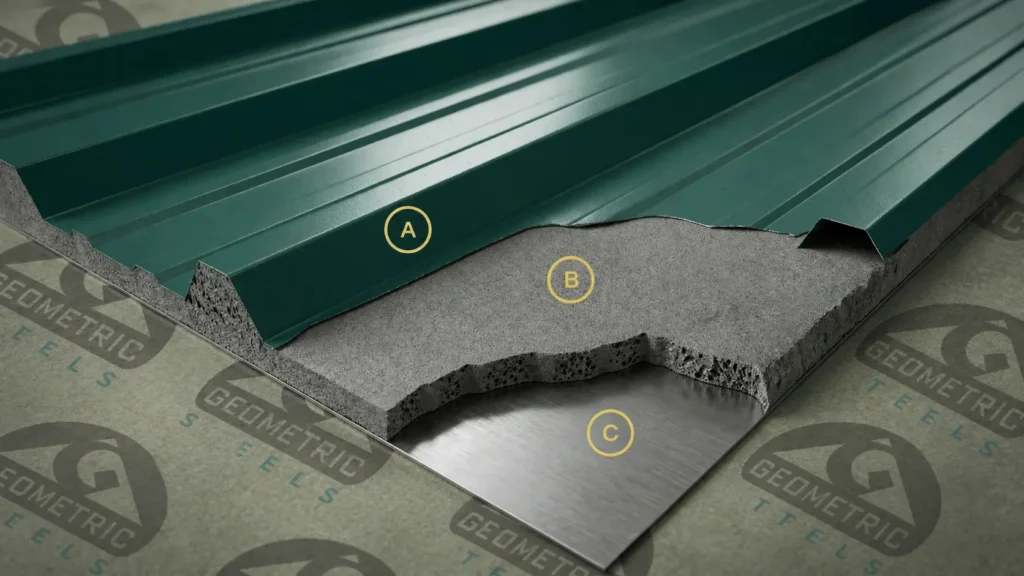
METAhybrid is Geometric Steels’ proprietary insulated metal roofing profile system — available in Single Skin and Double Skin configurations. It is not a standard PIR or PUF sandwich panel. The key differentiator is the hybrid construction: a high-performance insulation core engineered between two PPGI/PPGL metal skins, with the outer skin profiled for structural performance and the inner skin finished for interior aesthetic requirements.
Single Skin Configuration
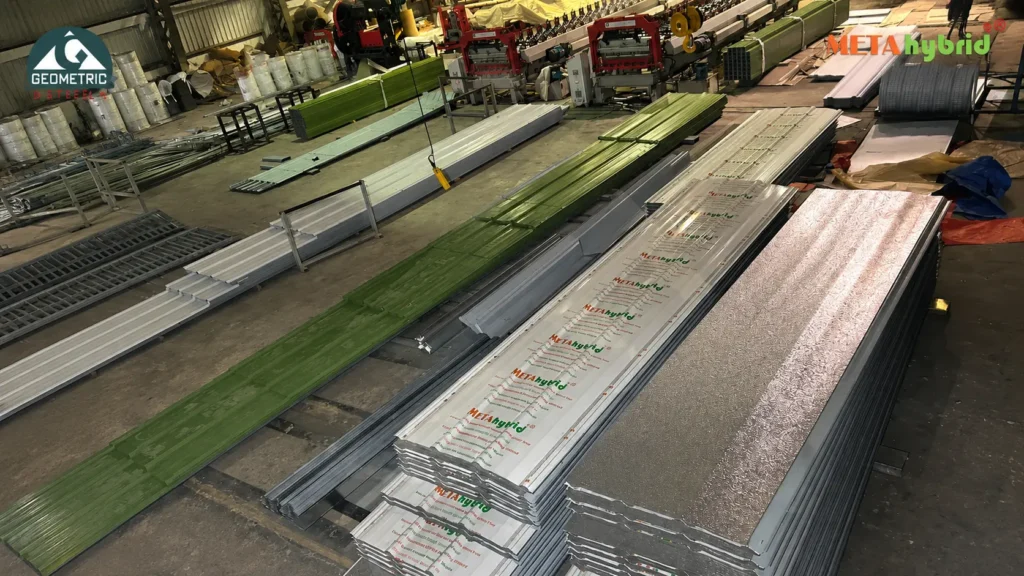
The Single Skin METAhybrid consists of a profiled outer metal sheet — typically in BIGspan or Ribstrong profile — with a factory-bonded insulation layer on the underside. This is specified where the insulation requirement is primarily thermal (not acoustic) and where the building’s interior does not require a finished ceiling surface. Commonly used in: warehouses, factory sheds, transit terminals, and semi-open industrial structures.
Double Skin Configuration
The Double Skin METAhybrid consists of a profiled outer sheet, an insulation core, and a factory-bonded inner liner sheet — creating a complete, finished roofing system in one component. This is the specification for: food processing facilities, pharmaceutical manufacturing, cold chain logistics, commercial buildings pursuing green building ratings, and any application requiring both thermal performance and internal hygiene or aesthetic standards.
What Makes the Insulation Core Different?
- The METAhybrid core achieves a tested R-value (thermal resistance) superior to standard PUF panels of equivalent thickness — verified by third-party testing under ISO 8302 / IS 3346 thermal conductivity measurement standards.
- The core material is non-combustible, contributing to a Class O fire rating — the highest fire performance classification available for a building envelope component under BS 476 Part 6 and Part 7.
- The insulation is factory-bonded under controlled conditions at Kurkumbh MIDC — eliminating the site-bonding variability that degrades performance in field-assembled alternatives.
- The system is ESG-compliant: the insulation core contains no HCFC or HFC blowing agents that violate the Montreal Protocol, making METAhybrid eligible for projects requiring environmental compliance documentation.
No other Indian roofing manufacturer currently produces an insulated metal profile system with this combination of CE marking, Class O fire rating, ESG-compliant insulation chemistry, and factory-bonded construction at ISO 9001-certified premises.
IS Standards, Green Building Codes, and Compliance Requirements
For MEP consultants and project architects specifying insulated roofing for industrial or commercial construction, understanding the full compliance matrix is essential. METAhybrid is designed to satisfy requirements across four distinct regulatory frameworks.
IS 3346:1980 — Method for Determination of Thermal Conductivity of Thermal Insulation Materials
This IS standard governs how thermal conductivity (lambda value, W/mK) is measured and reported for insulation materials in India. METAhybrid’s insulation core has been tested to this standard. When evaluating competing products, always request the IS 3346 test certificate — not just a manufacturer’s quoted value, which is frequently based on ideal laboratory conditions rather than installed performance.
National Building Code of India 2016 — Part 8, Section 1: Lighting and Ventilation
NBC 2016 Part 8 Section 1 sets minimum thermal performance requirements for building envelopes in climate zones across India. For composite climate zones (Delhi, Agra, Lucknow) and hot-dry zones (Ahmedabad, Jodhpur, Nagpur), the code specifies maximum U-values for roof assemblies in air-conditioned buildings. METAhybrid’s documented U-value satisfies NBC 2016 requirements for all Indian climate zones.
ECBC 2017 — Energy Conservation Building Code
The Energy Conservation Building Code (ECBC 2017), mandatory for commercial buildings above 500 sqm in BEE-notified states, specifies maximum roof U-values of 0.261 W/m²K for air-conditioned commercial buildings. The METAhybrid Double Skin system achieves U-values well within ECBC 2017 compliance thresholds, making it the correct specification for all ECBC-regulated construction projects.
GRIHA (Green Rating for Integrated Habitat Assessment)
India’s national green building rating system awards points under Criterion 8 (Optimise Energy Performance) for roof insulation that reduces the HVAC cooling load below the base case building. METAhybrid Double Skin qualifies for this criterion, contributing points toward GRIHA 3-Star, 4-Star, and 5-Star ratings. For government buildings, institutions, and PSU projects (where GRIHA rating is increasingly mandated), METAhybrid is the correct roofing specification.
LEED v4 India
Under LEED v4 EA Prerequisite: Minimum Energy Performance, roof assemblies must meet ASHRAE 90.1-2010 insulation requirements. The METAhybrid system provides documented thermal performance data in the format required for LEED energy modelling submissions. The ESG-compliant insulation chemistry supports LEED credits under Materials and Resources (Low Emitting Materials) and Indoor Environmental Quality categories.
IS 1641 to IS 1644 — Fire Safety Standards for Buildings
METAhybrid’s Class O fire rating is the benchmark classification under BS 476 (adopted by reference in Indian fire codes for industrial buildings). Class O means the outer surface of the product has a fire propagation index not exceeding 12, with a sub-index not exceeding 6 — the most restrictive surface spread of flame classification available. For pharmaceutical facilities, food processing plants, and warehouses storing combustible goods, this specification is frequently mandated by the site’s fire NOC conditions.
The ROI Calculation: When Does METAhybrid Pay for Itself?
The decision to specify METAhybrid over standard single-skin roofing is a capital expenditure decision. The upgrade cost is real and the payback period is calculable. Here is the analysis for three building types that represent METAhybrid’s primary application segments.
Scenario A: 5,000 sqm Pharmaceutical Manufacturing Facility, Pune
| Factor | Value |
| Standard roofing + HVAC upgrade to compensate | ₹28–34 lakhs for additional cooling capacity |
| METAhybrid Double Skin premium over standard | ₹12–16 lakhs |
| Annual HVAC saving (electricity, Pune rates) | ₹5.2L – ₹6.8L per year |
| Payback on premium cost | 2.2 – 3.1 years |
| Value at year 10 (savings minus premium) | ₹36L – ₹52L net saving |
Scenario B: 15,000 sqm Cold Chain Logistics Hub, Mumbai-Pune Corridor
Cold chain facilities operate HVAC systems at higher intensity and for longer hours than standard warehouses. The roof’s thermal performance directly impacts refrigeration compressor load — and compressor electricity cost is typically the single largest operating expense in a cold chain facility after labour.
| Factor | Value |
| Refrigeration load reduction with METAhybrid | 28–38% vs standard single-skin |
| Annual electricity saving (15,000 sqm, 24-hr ops) | ₹22L – ₹31L per year |
| METAhybrid premium for 15,000 sqm | ₹32–42 lakhs |
| Payback period | 1.4 – 1.9 years |
| GRIHA/LEED rating uplift | Contributes to 3–4 additional rating points |
For cold chain and pharmaceutical applications, the payback period on METAhybrid insulation is frequently under 2 years. No comparable roofing product in India delivers this return with CE certification and Class O fire rating in a single component.
Scenario C: 3,000 sqm Commercial Office Building, IT Campus, Bengaluru
For commercial construction pursuing LEED or GRIHA certification, METAhybrid contributes to rating points that directly affect the building’s valuation, rental premium, and regulatory compliance status under Karnataka’s mandatory green building policy for buildings above 20,000 sqft.
| Factor | Value |
| ECBC 2017 U-value requirement (roof) | Max 0.261 W/m²K |
| METAhybrid Double Skin U-value | Compliant — available on request |
| Annual HVAC saving vs bare metal roof | ₹3.8L – ₹5.2L per year |
| LEED EA credit contribution | Supports Optimised Energy Performance credit |
METAhybrid vs PUF Sandwich Panel vs Standard Metal Sheet: The Specification Decision
Three products compete for the thermal insulated roofing specification in India. Here is the honest comparison that every MEP consultant and procurement head should run before finalising a BOQ.
| Specification Factor | METAhybrid (GS) | PUF Sandwich Panel (generic) | Standard Single-Skin Metal Sheet |
| Thermal insulation (R-value) | High — factory bonded, verified | High — but site-bonding variability | None |
| Fire rating | Class O — highest rating | Varies — many PUF cores are Class 1 only | Not rated |
| CE Certification | Yes | Rarely — check carefully | No |
| ISO 9001 manufacturing | Yes — IAF accredited | Varies by manufacturer | Varies |
| ESG-compliant insulation chemistry | Yes — no HCFC/HFC | Many use HCFC blowing agents | N/A |
| ECBC 2017 compliance | Yes | Some — verify U-value | No |
| GRIHA / LEED eligible | Yes — with documentation | Some products | No |
| Structural profile integration | Yes — profiled outer skin | Flat panel — requires separate sheeting | Full structural range |
| Available from Indian manufacturer | Yes — Pune, Maharashtra | Yes | Yes |
| Project references | Samruddhi Mahamarg, Z-Morh, Philippines Metro | Various — typically undocumented | Universal |
A critical issue with generic PUF sandwich panels: the insulation core is frequently bonded on-site or under uncontrolled factory conditions, degrading both thermal performance and structural integrity. Always request the manufacturing quality control protocol — not just the spec sheet.
Where METAhybrid Has Been Specified: Project References
The insulation performance of a roofing product is ultimately proved by operational data from real buildings, not laboratory test certificates alone. METAhybrid has been installed across a range of landmark and infrastructure projects where thermal performance was a primary specification requirement.
Samruddhi Mahamarg — India’s Longest Greenfield Expressway
The Nagpur-Mumbai Super Communication Expressway (Samruddhi Mahamarg), spanning 701 km, specified Geometric Steels roofing systems for toll plaza and service station structures along its entire corridor. Toll plaza structures require effective thermal management to maintain habitable internal conditions for operational staff across the full temperature range of the Vidarbha and Marathwada climate zones — from sub-10°C winter mornings to 47°C summer afternoons.
Z-Morh Tunnel, Ladakh — 11,500 Feet Altitude
The Z-Morh Tunnel connecting Sonamarg to Kangan in Ladakh is one of India’s most technically demanding infrastructure projects — operating at 11,500 feet altitude in sub-zero winter conditions. Geometric Steels products were specified for facility structures associated with this project, validating thermal performance under conditions of extreme cold and altitude-related material stress that no standard roofing product could sustain.
Philippines Metro Project
Geometric Steels’ export to the Philippines Metro transit project confirms that METAhybrid’s thermal performance specifications meet international project requirements — where independent engineering review by the project’s international consultants validates the product against ASHRAE and ISO standards, not just Indian IS standards.
METAhybrid Technical Specifications: BOQ Reference Data
| Parameter | METAhybrid — Geometric Steels |
| System Type | Factory-bonded insulated metal roofing profile — Single Skin & Double Skin |
| Outer Skin Material | PPGI / PPGL (Galvanise / Galvalume) — Al-Zinc alloy coating, 150–180 g/m² |
| Outer Skin Profile | BIGspan (1060mm cover) or Ribstrong profile — specified at order stage |
| Inner Liner Skin (Double Skin) | PPGI liner sheet, colour-coated, smooth finish, 0.47mm thick |
| Insulation Core | High-performance mineral fibre / PIR — specified by project thermal requirements |
| Available Insulation Thickness | 50mm / 75mm / 100mm / 150mm (custom on request) |
| Thermal Conductivity | Lambda value per IS 3346 test — certificate available on request |
| Fire Rating | Class O — BS 476 Part 6 and Part 7 |
| ECBC 2017 Compliance | U-value meets ECBC 2017 roof requirements — documentation available |
| ESG / Environmental | No HCFC/HFC blowing agents. Montreal Protocol compliant. |
| Acoustic Performance | Sound reduction index Rw improved vs single-skin (Double Skin configuration) |
| Condensation Control | Factory-bonded vapour control layer prevents interstitial condensation |
| Length | Custom mill-cut to project length — up to 12m standard; longer on request |
| Certifications | ISO 9001:2015 (IAF MLA) | CE Marked | Manufactured at Kurkumbh MIDC, Pune |
Frequently Asked Questions
Q1: What is the difference between METAhybrid and a PUF sandwich panel?
Both are insulated roofing systems, but the differences are significant in practice. METAhybrid uses a profiled outer metal skin — meaning it functions as both the structural roofing sheet and the insulation system in one component. A standard PUF sandwich panel uses flat or lightly profiled metal skins bonded to a polyurethane foam core. METAhybrid’s Class O fire rating (non-combustible insulation option) contrasts with many PUF panels, which use combustible polyurethane cores rated only Class 1 or unrated. For pharmaceutical, food processing, and government building applications where fire safety is a compliance requirement, METAhybrid is the correct specification.
Q2: Does METAhybrid qualify for GRIHA rating points?
Yes. METAhybrid Double Skin qualifies for credit under GRIHA Criterion 8 (Optimise Energy Performance) by demonstrably reducing the building’s HVAC cooling load below the GRIHA base case building. It also supports GRIHA credits for materials with low environmental impact (ESG-compliant insulation chemistry). Your GRIHA consultant will require the thermal performance certificate (lambda value, R-value, U-value of the roof assembly), CE certification, and the IS 3346 test report — all of which Geometric Steels provides as standard project documentation.
Q3: What IS standard applies to insulated roofing sheets in India?
The primary standards are: IS 3346:1980 (thermal conductivity measurement), NBC 2016 Part 8 Section 1 (building envelope thermal performance), and ECBC 2017 (energy performance requirements for commercial buildings). For fire performance, BS 476 Parts 6 and 7 are the referenced standards in Indian fire codes for building envelope materials. Geometric Steels can provide compliance documentation referencing each of these standards for inclusion in your tender technical submission.
Q4: Can METAhybrid be retrofitted onto an existing factory roof?
Yes, in most cases. The Double Skin system can be installed as an over-roofing system on an existing single-skin metal roof, provided the existing purlins have adequate structural capacity for the additional dead load. Our technical team will review your existing structural drawings and advise whether over-roofing is feasible or whether full roof replacement is the appropriate approach. In our experience, approximately 70% of industrial re-roofing projects can accommodate the METAhybrid system without structural modification.
Q5: What is the price of METAhybrid insulated roofing sheet per sqm?
Pricing depends on configuration (Single Skin vs Double Skin), insulation core thickness, outer profile specification, quantity, and delivery location. Geometric Steels provides project-specific quotations with a complete BOQ breakdown — not catalogue list prices, which are meaningless without knowing your project’s specific thermal requirements. Contact our team with your building dimensions, thermal performance requirements, and project timeline for a detailed quotation within 48 hours.
Q6: Is METAhybrid suitable for cold storage and food processing facilities?
Yes — this is one of METAhybrid’s primary application segments. The Double Skin system provides the thermal resistance required for cold chain facilities, the Class O fire rating required for food processing facilities’ fire NOC compliance, and the smooth inner liner finish required for food safety hygiene standards. The vapour control layer prevents interstitial condensation — the primary failure mode for insulated roofing in high-humidity food processing environments. We can provide a full application-specific technical datasheet for cold chain and food processing projects on request.
How to Specify METAhybrid Correctly in Your BOQ
For MEP consultants and project architects writing tender specifications, here is the recommended specification language for METAhybrid Double Skin in a commercial or industrial project BOQ:
“Insulated metal roofing system: factory-bonded double skin insulated roofing panel, PPGL outer skin with [BIGspan / Ribstrong] profile at [1060mm / specified] cover width, [100mm] PIR/mineral fibre insulation core with lambda value not exceeding [0.022] W/mK (as per IS 3346 test certificate), PPGI inner liner sheet, Class O fire rating (BS 476 Parts 6 and 7), ECBC 2017 U-value compliant, ESG-compliant insulation chemistry (no HCFC/HFC blowing agents), manufactured at ISO 9001:2015 (IAF MLA) certified premises, CE marked. Geometric Steels METAhybrid or pre-approved equivalent.”
The phrase ‘or pre-approved equivalent’ is standard tender language. In practice, specifying CE marking, Class O fire rating, IAF-accredited ISO certification, and ECBC 2017 compliance simultaneously eliminates all products from the market that do not meet this standard — leaving METAhybrid as the only qualifying product from an Indian manufacturer.
Technical Documentation and BOQ Support
If your project demands a thermal insulated roofing system with CE certification, Class O fire rating, ECBC 2017 compliance, and GRIHA-eligible documentation — and you need the numbers to prove it to your client or approval authority — our technical team provides all of this at no cost as part of the specification process.
We provide:
- Thermal performance certificate (lambda value, R-value, U-value of complete roof assembly)
- IS 3346 test report for insulation core material
- CE certification and ISO 9001:2015 (IAF MLA) certification documents
- ECBC 2017 compliance statement for your project’s compliance file
- GRIHA / LEED supporting documentation package
- BOQ with full quantities, specifications, and project-specific pricing
- Structural assessment for over-roofing feasibility (existing buildings)
For More Visit Here: https://geometricsteels.com/thermal-insulated-roofing-sheets/
Contact Geometric Steels Roll Forming Pvt. Ltd.
Phone: +91 8550995556 | geometricsteels.com
Manufacturing: Kurkumbh MIDC, Pune, Maharashtra
ISO 9001:2015 | CE Marked | Established 2006