When the developers of a new indoor badminton facility began evaluating roofing solutions, they faced a challenge common to large-span metal structures across India: excessive heat buildup.
The objective was simple.
Build a professional indoor badminton court that remained comfortable for players throughout the year.
The challenge, however, was far more complex.
Conventional roofing systems risked turning the facility into an uncomfortable heat trap during summer months, potentially affecting player performance, visitor experience, and long-term operating costs.
After evaluating multiple options available in the market, the project team partnered with Geometric Steels to engineer a roofing solution that combined advanced thermal insulation with optimized ventilation strategies.
The result was a measurable reduction in heat gain, improved indoor comfort, and a facility capable of supporting consistent sporting activity even during peak summer conditions.
Project Overview
Client
Aspire Sports CLub
Industry
Sports Infrastructure
Location
Pune Solapur Highway, Manjari Farm, Pune, Maharashtra, 412307
Building Type
Indoor Badminton Court
Roofing + Ventilation
Suplied Roofing + Ventilation for one-stop solutions.
Completion Year
2024
Primary Objective
Develop a thermally comfortable indoor sports facility without excessive dependence on mechanical cooling systems.
Background
Indoor sports facilities face a unique challenge.
Unlike industrial buildings, where workers may tolerate moderate environmental variations, sports facilities require conditions that support physical performance, comfort, and endurance.
Athletes generate substantial body heat during gameplay.
When combined with solar heat gain through poorly designed roofing systems, indoor temperatures can quickly rise to uncomfortable levels.
The developers of this badminton court recognized this challenge early in the planning stage.
They understood that selecting the wrong roofing system could compromise the facility’s usability, increase operational expenses, and negatively impact the player experience.
Rather than making a decision based solely on product brochures or supplier claims, the team sought measurable evidence.
The Challenge
The project team faced three critical concerns.
1. Heat Accumulation
Traditional metal roofing systems are highly susceptible to solar radiation.
Without proper thermal protection, heat absorbed by the roof can radiate into the occupied space below, creating uncomfortable playing conditions.
2. Long-Term Operating Costs
Mechanical cooling systems can help control indoor temperatures.
However, they also introduce significant energy consumption and maintenance expenses.
The client wanted a passive solution that reduced heat gain at the source.
3. Performance Verification
The market offered numerous insulation products, each claiming superior thermal performance.
The client needed proof rather than promises.
The question was not:
“Which product sounds best?”
The question was:
“Which system delivers measurable results?”
Industry Misconceptions
One of the most common assumptions in roofing design is that thermal performance depends solely on insulation thickness.
The project team encountered numerous solutions emphasizing thicker insulation layers as the primary strategy for heat reduction.
However, Geometric Steels approached the challenge differently.
Through years of experience in industrial and commercial roofing projects, the company understood that thermal comfort depends on multiple interconnected factors:
- Heat reflection
- Heat absorption
- Heat transfer
- Air movement
- Ventilation efficiency
A roofing system cannot be evaluated based solely on insulation thickness.
Its overall thermal behavior must be considered.
Geometric Steels Assessment,
The engineering team conducted a detailed evaluation of the project requirements.
The assessment focused on:
- Solar heat exposure
- Building orientation
- Roof geometry
- Ventilation opportunities
- Occupancy patterns
- Expected thermal loads
The findings confirmed that controlling radiant heat transfer would be critical to maintaining indoor comfort.
This led to the recommendation of the META Hybrid roofing solution.
The Solution
METAHybrid Roofing System
Geometric Steels proposed the META Hybrid roofing system as the primary thermal barrier.
At first glance, the recommendation raised concerns.
The insulation layer measured only 6 mm.
Compared with conventional thick insulation systems available in the market, this seemed surprisingly minimal.
The project stakeholders naturally questioned whether such a solution could deliver the required performance.
Instead of relying on theoretical claims, Geometric Steels chose to demonstrate the results through testing.
Validation Through Real-World Testing
Engineering decisions should be supported by measurable data.
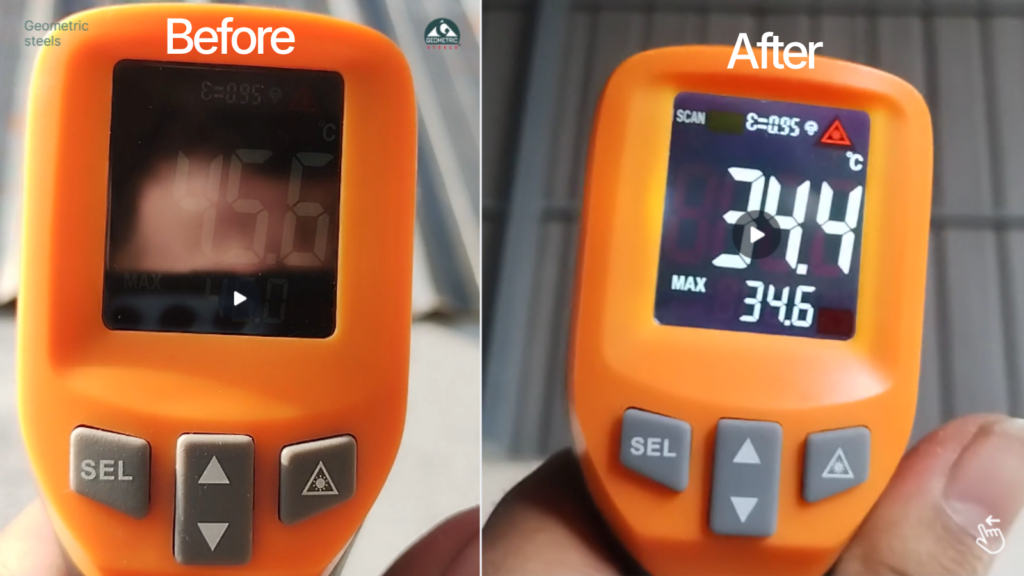
To validate the effectiveness of the proposed system, Geometric Steels conducted comparative thermal testing.
The test compared conventional roofing performance against the META Hybrid system under similar environmental conditions.
The results were significant.
Surface Temperature Comparison
Conventional System: 46°C
META Hybrid System: 34.2°C
Observed Temperature Reduction
11.8°C Reduction
The test demonstrated that thermal performance is not determined solely by insulation thickness.
The ability to reflect radiant heat plays an equally important role.
This evidence provided the confidence required to move forward with implementation.
Beyond Insulation: The Ventilation Strategy
Many roofing projects focus exclusively on insulation.
This project adopted a more comprehensive approach.
Geometric Steels integrated:
Thermal Insulation
To reduce heat transfer through the roof envelope.
Natural Ventilation
To continuously remove accumulated hot air from the structure.
Airflow Optimization
To improve thermal comfort throughout the occupied space.
The combination of insulation and ventilation created a complete thermal management system rather than a standalone roofing installation.
Implementation
The roofing and ventilation systems were installed according to project specifications and integrated into the overall facility design.
Particular attention was given to:
- Installation quality
- Thermal continuity
- Ventilation effectiveness
- Structural compatibility
The project was completed while maintaining engineering and quality standards throughout the execution process.
Results
Following implementation, the facility achieved several important outcomes.
Improved Thermal Comfort
The reduction in heat transfer contributed to significantly more comfortable indoor conditions.
Reduced Dependence on Mechanical Cooling
By minimizing heat gain and improving natural airflow, the facility reduced its reliance on energy-intensive cooling systems.
Enhanced Player Experience
Athletes could use the facility under more comfortable conditions, improving usability and overall satisfaction.
Long-Term Operational Efficiency
Lower cooling demand translated into reduced operating costs and improved sustainability.
Key Takeaways
This project reinforces several important lessons for sports infrastructure developers.
Lesson 1
Thermal comfort begins with roof design.
Lesson 2
Insulation thickness alone does not determine thermal performance.
Lesson 3
Measured data is more valuable than marketing claims.
Lesson 4
Ventilation and insulation must work together.
Lesson 5
Engineering-led solutions outperform product-led recommendations.
Strategic Impact
For facility owners, roofing should not be viewed merely as a protective covering.
It is a critical component that directly influences:
- User comfort
- Energy consumption
- Building performance
- Operational costs
- Long-term asset value
This project demonstrates how a scientifically engineered roofing and ventilation system can create measurable business value beyond basic weather protection.
About Geometric Steels
Geometric Steels specializes in engineered roofing, ventilation, insulation, and building envelope solutions for industrial, commercial, institutional, and infrastructure projects across India.
By combining technical expertise with performance-driven engineering, the company helps organizations create facilities that are more efficient, comfortable, and sustainable.
Every solution is backed by practical engineering, measurable outcomes, and a commitment to long-term performance.
Contact Geometric Steels Roll Forming Pvt. Ltd.
Phone: +918793944487 | geometricsteels.com
Manufacturing: Kurkumbh MIDC, Pune, Maharashtra