A smoke vent is life safety equipment. Learn how to navigate CE marking in India, EN 12101-2 standards, and what to look for from Geometric Steels.
Word Count: ~2,700 words | Reading Time: ~11 minutes
A Smoke Vent Is Life Safety Equipment — Its Certification Deserves More Scrutiny Than Its Price
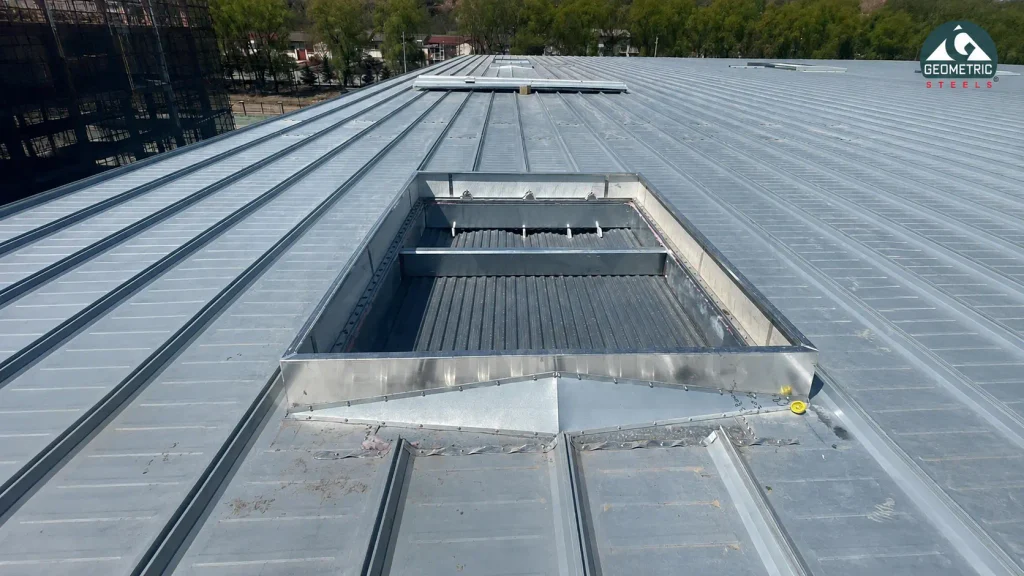
A smoke vent’s job, in a fire event, is to open reliably, exhaust hot smoke and combustion gases from a building before they reach untenable levels for occupants and fire fighters, and to keep the escape routes below clear enough to see and breathe. This is a life safety function, not a general ventilation convenience — which means the standard of scrutiny applied to specifying, procuring, and maintaining a smoke vent should be materially higher than for a standard passive roof vent.
‘CE marked’ is a phrase used loosely in Indian product marketing, sometimes as a general quality signal rather than a specific, verifiable compliance claim tied to a defined standard and test. For a smoke vent specifically, understanding exactly what CE marking covers — and what it does not — is essential for a fire consultant or specifying architect who needs to be confident the product will actually perform the function it is being specified for.
This guide explains what CE marking means for smoke and heat exhaust ventilators, what the relevant European and Indian standards say, and what to verify from any manufacturer — including Geometric Steels — before specifying a smoke vent for your project.
This guide provides general background on CE marking and smoke ventilation standards. It is not fire engineering advice. The specific smoke and heat exhaust ventilation strategy, product selection, and quantity for your building must be designed and specified by a qualified fire consultant with reference to your project’s fire safety design basis and the applicable local authority requirements. Figures and claims in this guide are general and indicative unless otherwise stated.
What CE Marking Actually Means for a Smoke Vent
CE marking indicates that a product has been assessed against the requirements of the relevant applicable European Union directive or regulation, and that it meets the essential requirements set out in the corresponding harmonised European standard. For construction products including smoke and heat exhaust ventilators, the relevant framework in Europe is generally the Construction Products Regulation, and the specific product standard most commonly referenced for natural smoke and heat exhaust ventilators is EN 12101-2.
EN 12101-2 sets out test methods and classification criteria for natural smoke and heat exhaust ventilators (NSHEVs), covering aspects including reliability under repeated operation, low-temperature operation, snow load resistance, wind load resistance, and the ventilator’s operation under exposure to heat. A product genuinely tested and classified to EN 12101-2, with a corresponding Declaration of Performance, provides meaningful, verifiable assurance of its tested performance envelope.
What CE Marking Does Not Automatically Mean
- It does not mean the product is automatically suitable for every building type, occupancy, or fire strategy — suitability depends on your project’s specific fire engineering design.
- It does not specify how many units, of what size, are required for your building — that quantity and layout calculation is a fire engineering exercise specific to your project.
- A general ‘CE marked’ claim on a company’s marketing material is not the same as a product-specific Declaration of Performance for the exact model and configuration you are being quoted — always request the actual document.
- CE marking under one product standard (for example, a general building products directive) is not the same as certification specifically to EN 12101-2 for smoke and heat exhaust ventilators — confirm which specific standard the CE marking relates to for the product in question.
For any smoke vent described as CE marked, request the actual Declaration of Performance (DoP) document, confirm it references EN 12101-2 (or the specific standard relevant to the product type), and confirm the DoP covers the exact model, size, and configuration you are ordering — not a different variant in the same general product family.
Smoke Ventilation in the Indian Regulatory Context
India does not have a single dedicated national standard for natural smoke and heat exhaust ventilators equivalent in scope to EN 12101-2. Smoke and heat venting requirements for Indian buildings are generally addressed through:
- The National Building Code of India 2016, Part 4 (Fire and Life Safety), which sets out general fire safety design principles, including provisions relevant to smoke management in certain building types and occupancies.
- Project-specific fire safety design, typically prepared by a fire consultant, which may reference international standards (including EN 12101 series standards) as the technical design basis, particularly for larger or more complex buildings, warehouses, and industrial facilities.
- Local fire authority requirements and the conditions attached to a project’s fire NOC (No Objection Certificate), which can include specific smoke ventilation requirements set by the approving authority.
- Insurance and underwriting requirements, particularly for large industrial and warehouse risks, which may specify smoke venting standards as a condition of cover.
Because there is no single mandatory Indian product standard occupying this space, many Indian fire consultants and specifiers reference EN 12101-2 directly as the technical basis for smoke vent specification — which is part of why CE marking to this specific standard is a meaningful differentiator for manufacturers serving this market. Confirm with your project’s fire consultant which standard and design basis is being applied for your specific building.
Electrical vs Pneumatic Actuation: General Comparison
Smoke vents are generally actuated (opened) by one of two general mechanisms — electrical (motor-driven) actuators or pneumatic (compressed gas cylinder-driven) actuators. The choice between them is a fire engineering and building services decision, not a matter of one being universally superior.
| Factor | Electrical Actuation | Pneumatic Actuation |
| Power source | Mains power with battery backup, generally required per applicable fire alarm system design | Compressed gas cylinder (commonly CO₂), released on activation |
| Typical integration | Integrates with the building’s fire alarm and detection system via control panel | Also integrates with fire detection, releasing gas on signal — confirm specific integration method with supplier |
| Maintenance consideration | Periodic testing of motor, battery backup, and control wiring per maintenance schedule | Periodic inspection and replacement/recharge of gas cylinders per maintenance schedule |
| Typical selection driver | Often selected where integration with an existing electrical fire alarm infrastructure is straightforward | Often selected where a fast-acting, self-contained release without dependency on continuous power is preferred |
Note: This is a general, category-level comparison. The correct actuation method for your specific project depends on your fire alarm system design, maintenance regime, budget, and your fire consultant’s specific design requirements. Actual performance, integration method, and maintenance requirements vary by manufacturer and specific product. Figures and characterisations can vary according to client requirements, project type, and location. Confirm the appropriate actuation method with your fire consultant before specifying.
Key Performance Parameters to Verify From Any Smoke Vent Supplier
Aerodynamic Free Area
The effective open area through which smoke can pass when the vent is open — this is the parameter your fire consultant’s smoke management calculation actually depends on, and it is typically less than the vent’s overall physical dimensions due to the geometry of the opening mechanism. Request the tested aerodynamic free area (sometimes referred to by the coefficient Cv in EN 12101-2 testing) for the specific model and opening angle, not just the vent’s outer frame dimensions.
Opening Angle and Opening Time
Confirm the vent’s opening angle (commonly referenced around 70 degrees in general industry practice for this product category, though the specific angle for the exact model you are considering should be confirmed) and the time taken to reach full open position from activation — both of which affect how quickly the design smoke exhaust rate is achieved.
Reliability and Repeated Operation Testing
EN 12101-2 testing includes reliability testing over a number of open/close cycles. Request the specific test data and cycle count for the model you are considering, rather than assuming reliability from a general product description.
Wind and Snow Load Classification
Where tested to EN 12101-2, vents are classified for their ability to open reliably under specific wind load conditions, and in some classifications, under snow load. Confirm the classification is appropriate for your project’s location and roof design conditions.
Low Temperature Operation
Confirm the tested low-temperature operating range for the actuator and vent mechanism is appropriate for your project’s climate.
Thermal Rating (Heat Exposure)
Confirm the vent’s classification for continued operation under exposure to hot smoke, referenced to the applicable EN 12101-2 classification, if this is a requirement of your project’s fire strategy.
The Geometric Steels Smoke Vent Range: General Overview
Geometric Steels manufactures Smoke Vent products in Electrical and Pneumatic actuation configurations at our Kurkumbh MIDC, Pune facility, under ISO 9001:2015 quality management, accredited under the IAF Multilateral Recognition Arrangement.
| Parameter | Geometric Steels Smoke Vent |
| Actuation options | Electrical and Pneumatic — confirm suitability for your fire alarm system with our technical team |
| Frame and cover construction | Includes thermal break aluminium framing and fire-rated cable, as applicable to the specific configuration — confirm exact specification at enquiry stage |
| CE marking | Held for applicable configurations — request the Declaration of Performance for the specific model and confirm it references EN 12101-2 for your project |
| Aerodynamic free area data | Available on request for the specific model and opening configuration — required for your fire consultant’s calculation |
| Custom sizing | Confirm available sizes and any custom sizing capability at enquiry stage |
| Quality certification | ISO 9001:2015 (IAF MLA accredited) |
Note: The parameters above describe the general nature of the Geometric Steels Smoke Vent range and are indicative only. Specific model configuration, actuation type, aerodynamic free area, CE marking scope, and sizing for your project must be confirmed directly with Geometric Steels at the quotation stage — including the actual Declaration of Performance for the exact model — and independently verified by your fire consultant. All figures are subject to change according to client requirements, project location, and current manufacturing capability. This is life safety equipment: do not rely on this general guide as a substitute for reviewing the specific product documentation for your project.
What to Request Before Specifying Any Smoke Vent
- The Declaration of Performance (DoP) for the exact model, size, and configuration being quoted — confirm it references EN 12101-2 or the applicable standard relevant to your project.
- Aerodynamic free area (Cv) data for the specific opening configuration, for your fire consultant’s smoke management calculation.
- Reliability, wind load, snow load, and low-temperature classification data from the relevant test report.
- Opening time and full-open confirmation method for integration with your fire alarm and building management system.
- Maintenance and testing schedule recommended by the manufacturer, and confirmation of local availability of spare parts and service support.
- ISO 9001:2015 certification status and accreditation body for the manufacturer.
- Confirmation of whether the supplier is the actual manufacturer or a reseller/importer, and who provides warranty and after-sales support in India.
Because a smoke vent is life safety equipment, we recommend that final product selection and quantity always be confirmed by your project’s qualified fire consultant, referencing the actual test documentation for the specific model under consideration — not a general product description or marketing claim, from Geometric Steels or any other manufacturer.
Frequently Asked Questions
Q1: What does CE marking on a smoke vent actually certify?
CE marking on a smoke and heat exhaust ventilator indicates the product has been assessed against a relevant harmonised European standard — most commonly EN 12101-2 for natural smoke and heat exhaust ventilators — covering aspects such as reliability, wind load resistance, and thermal performance. It does not certify that the product is the correct quantity or type for your specific building; that determination is made by your fire consultant’s project-specific design. Always request the Declaration of Performance for the exact model to confirm what has actually been tested and certified.
Q2: Is CE marking legally required for smoke vents used in India?
India does not have a single mandatory national requirement for CE marking on smoke vents. However, many fire consultants specify products tested and CE marked to EN 12101-2 as their technical design basis, particularly for larger, more complex, or internationally-specified buildings, because India does not have an equivalent dedicated national product standard. Confirm with your project’s fire consultant and the relevant fire NOC authority what certification is required or expected for your specific project.
Q3: What is the difference between electrical and pneumatic smoke vent actuation?
Electrical actuation uses a motor, typically integrated with the building’s fire alarm system and backed up by battery power. Pneumatic actuation uses a compressed gas cylinder released on activation to open the vent. Both are established actuation methods; the correct choice for your project depends on your fire alarm system architecture, maintenance regime, and your fire consultant’s specific design requirements — confirm with your fire consultant rather than assuming one method is universally preferable.
Q4: Can Geometric Steels provide the Declaration of Performance for its smoke vent products?
Yes, we can provide the Declaration of Performance and relevant test documentation for the specific smoke vent model and configuration being quoted. We recommend requesting this early in your project’s specification process so your fire consultant can review it as part of your building’s fire safety design.
Q5: How many smoke vents does my building need?
This is determined by your project’s fire consultant through a smoke management calculation specific to your building’s geometry, occupancy, and fire strategy — it is not a figure that can be generalised across building types. We can provide the aerodynamic free area and relevant technical data for our smoke vent products to support your fire consultant’s calculation, but the quantity and layout design itself must be carried out by a qualified fire engineer for your specific project.
Q6: What maintenance does a CE marked smoke vent require?
Smoke vents require periodic testing and maintenance to remain reliable — including functional testing of the opening mechanism, inspection of seals and weatherproofing, and for electrical units, testing of the actuator, wiring, and battery backup, or for pneumatic units, inspection and timely replacement or recharge of gas cylinders. The specific maintenance schedule should follow the manufacturer’s recommendations for the exact model installed and should be incorporated into your building’s fire safety maintenance programme. Contact us for the maintenance guidance document for our smoke vent range.
Request Certification Documents and Technical Data for Your Project
Send us your building type, fire alarm system architecture, and any specific standard your fire consultant has specified. We will confirm the appropriate Smoke Vent configuration, provide the Declaration of Performance and aerodynamic free area data for your fire consultant’s calculation, and prepare a project-specific quotation.
Every Smoke Vent enquiry to Geometric Steels receives:
- Actuation type recommendation (Electrical or Pneumatic) based on your fire alarm system
- The Declaration of Performance for the specific model and configuration
- Aerodynamic free area data for your fire consultant’s smoke management calculation
- Reliability, wind, snow, and low-temperature classification data, where available
- ISO 9001:2015 (IAF MLA) certification documentation
- Maintenance guidance for the installed system
- A project-specific quotation and delivery timeline
For More Visit Here: https://new.geometricsteels.com/smoke-ventilation-system-for-industrial-infrastructure
Contact Geometric Steels Roll Forming Pvt. Ltd.
Phone: +91 8550995556 | geometricsteels.com
Manufacturing: Kurkumbh MIDC, Pune, Maharashtra
ISO 9001:2015 (IAF MLA) | CE Marked (applicable products) | Established 2006
India Builds Under Our Roof. | 20 Years · 64 Products · ISO · CE · IAF Certified