Discover essential C purlin specifications, structural applications, and Indian standards. Your guide to sourcing quality cold-formed steel purlins in Pune.
Word Count: ~2,600 words | Reading Time: ~10 minutes
C Purlin Is a Simple Shape With a Specification That Is Easy to Get Wrong
The C purlin — a cold-formed steel channel section — is one of the most familiar components in industrial steel construction. Its simplicity is part of the reason it is often under-scrutinised at procurement stage: a channel is a channel, the thinking goes, so the decision comes down to price and delivery date.
In practice, C purlin specification involves several variables — web height, flange width, lip return, thickness, steel grade, and coating — that materially affect structural performance and service life, and that vary between manufacturers even for products described with the same nominal size. For a Pune-area project, there is also a straightforward practical question worth asking: is the manufacturer actually local, and does that matter for your project?
This guide sets out the general engineering background on C purlins, what to verify from any manufacturer, and what local manufacturing in the Pune area does and does not change about the buying decision.
All technical specifications, dimensions, load capacities, and pricing indications referenced in this blog are indicative. Structural design values must be confirmed by a qualified structural engineer based on project-specific loading, span, and code requirements. Final product specifications are confirmed by Geometric Steels at the project quotation stage.
What Is a C Purlin and Where Is It Used?
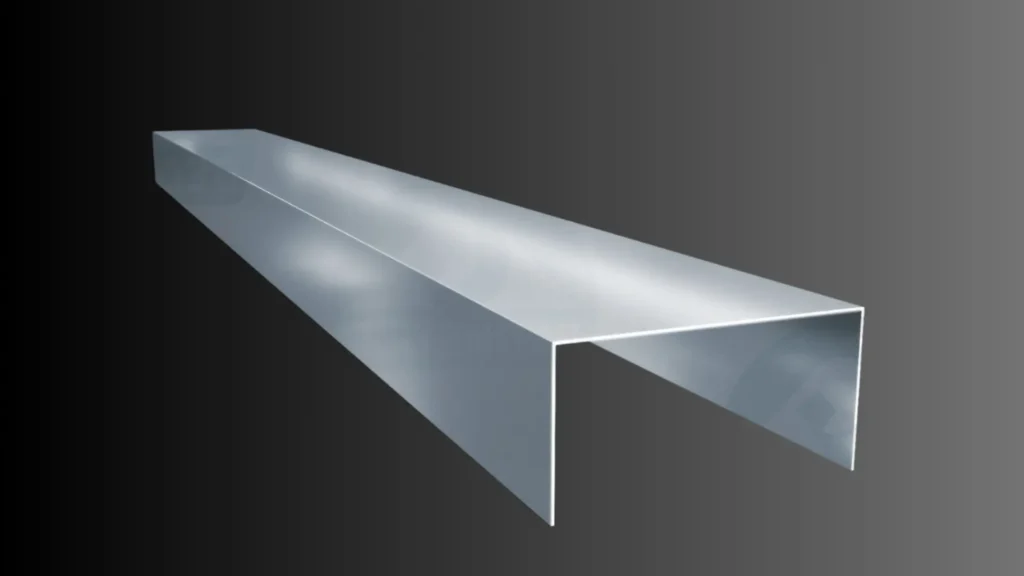
A C purlin is a cold-formed steel structural section, shaped like the letter C (a channel with inward-turned lips at the flange edges), used as a secondary structural member in roof and wall systems. Like the Z purlin, it spans between primary structural members — rafters, trusses, or portal frames — and provides direct support for the roofing sheet, insulated panel, or wall cladding fixed to it.
The C profile’s axis-symmetric geometry (symmetric about its web) differs from the Z profile’s point-symmetric geometry, which affects how adjacent sections are connected at supports and how the section behaves under load. This is a general structural engineering distinction, not a claim specific to any one manufacturer’s product.
Typical Applications
- Roof and wall secondary structure for pre-engineered buildings (PEB) and conventional steel-framed sheds
- Single-span structures, and multi-span structures using sleeve or overlap connections at internal supports
- Industrial warehouses, factory buildings, and logistics facilities
- Agricultural and agro-processing structures
- Mezzanine floor edge trimmers and secondary framing, in combination with composite steel decking
- Wall girts (horizontal secondary members supporting wall cladding)
C Purlin vs Z Purlin: When Each Is Typically Used
The choice between C and Z purlin sections is a structural engineering decision, based on span configuration and the overall structural design approach — not a matter of one section type being universally better than the other. The following is general background information; the correct choice for any specific project must be confirmed by the project’s structural engineer.
| Structural Factor | C Purlin | Z Purlin |
| Section symmetry | Axis-symmetric (channel-shaped) | Point-symmetric (Z-shaped) |
| Connection at internal supports | Commonly connected using sleeve or back-to-back arrangements, depending on design | Commonly nested and lapped for continuous multi-span action |
| Typical span application | Widely used for single-span applications and wall girts; also used in multi-span systems with appropriate connection design | Widely used for continuous multi-span roof systems using lapped connections |
| Common in PEB roof/wall systems | Very common — widely specified for PEB wall girts and roof purlins | Very common — widely specified for PEB roof purlins |
| Design guidance | Cold-formed steel design principles — refer to IS 801 and manufacturer load tables | Cold-formed steel design principles — refer to IS 801 and manufacturer load tables |
Note: This comparison is a general engineering reference only and should not be used as a substitute for project-specific structural design. The correct purlin type, section size, and connection configuration for any project must be determined by the project’s structural engineer based on span, loading, deflection limits, and the applicable design code. Figures and characterisations above can vary according to project requirements, span configuration, and location.
C Purlin Web Height Range: Matching the Section to the Application
As with the Z purlin, C purlins are manufactured across a range of web heights, and selecting a section that closely matches the structural requirement — rather than defaulting to the nearest commonly available size — avoids unnecessary steel tonnage and cost. Geometric Steels manufactures C purlins across a web height range including an 80mm option, in addition to the more commonly available 100mm to 300mm range.
| Web Height | Indicative Application Range | Availability |
| 80mm | Light secondary structures, wall girts, smaller-span applications — subject to structural design verification | Available from Geometric Steels; confirm availability with other suppliers |
| 100mm | Standard light industrial structures | Commonly available across the Indian market |
| 150mm | Medium-span structures — subject to structural design | Commonly available across the Indian market |
| 200mm | Larger-span structures — subject to structural design | Commonly available across the Indian market |
| 300mm | Long-span or heavy-load structures — subject to structural design | Available from most established manufacturers |
Note: Web height application ranges above are indicative and general in nature. The correct web height, flange width, lip size, thickness, and yield strength for any specific span and load must be determined by the project’s structural engineer using the manufacturer’s load-span tables. Availability of specific web heights from other manufacturers may vary — confirm directly with each supplier. All figures are subject to change according to client requirements, project location, and current production capability.
Geometric Steels does not claim exclusive ownership of any specific web height dimension as proprietary technology — these are standard cold-formed section sizes within our manufacturing range. The relevant point for a structural engineer is availability: confirm with any prospective supplier, including GS, whether the specific web height, thickness, and yield strength combination required by your design is available and can be manufactured to your programme.
Why a Pune-Based C Purlin Manufacturer Is Relevant for Local Projects
For a project based in Pune, Kurkumbh, Chakan, Talegaon, or the surrounding industrial belt, sourcing C purlins from a manufacturer within the same district carries the same general logistics considerations that apply to any bulky structural steel product.
- Long structural sections are dimensionally sensitive to transport handling — shorter transit distances generally reduce the number of handling events and associated bending or damage risk.
- Site coordination — confirming bay spacing, resolving a dimensional query, or arranging a follow-on delivery — is generally easier with a nearby manufacturer.
- Mill-cut-to-length orders matched to your specific bay spacing can often be turned around with a more predictable schedule when transport distance is short, though actual lead time depends on production capacity at the time of order.
- After-sales queries are typically more straightforward to resolve directly with a local manufacturer.
These are general logistics considerations, not a claim that a non-local supplier cannot deliver good service or product quality. Local proximity is one factor among several — including section availability, material certification, and pricing — that a Pune-area procurement team should weigh in a fair evaluation of any supplier.
Geometric Steels: C Purlin Manufacturing at Kurkumbh MIDC, Pune
Geometric Steels manufactures Z and C purlins at its Kurkumbh MIDC, Pune facility, under ISO 9001:2015 quality management, accredited under the IAF Multilateral Recognition Arrangement.
| Parameter | Geometric Steels C Purlin |
| Location | Kurkumbh MIDC, Pune district, Maharashtra |
| Web height range | 80mm to 300mm — confirm specific availability at enquiry stage |
| Yield strength | 240 MPa or 350 MPa — confirm at order stage with material test certificate |
| Coating | Hot-dip galvanised — coating class confirmed per project requirement (IS 277) |
| Custom lengths | Mill-cut to specified length — standard capability up to 12m; longer lengths on request, subject to confirmation |
| Load-span data | Available on request for specific section, grade, and span configuration — for structural engineer verification |
| Quality certification | ISO 9001:2015 (IAF MLA accredited) |
| CE marking | Held across applicable GS products — confirm applicability for purlins per project |
| Material traceability | Material test certificates available per coil batch from primary steel producers |
Note: The parameters above describe the general capability of the Geometric Steels C purlin manufacturing range and are indicative only. Specific web heights, yield strengths, coating classes, and lengths available for a given project are confirmed at the quotation stage and are subject to change based on client requirements, structural design, project location, and current manufacturing capacity. Structural load capacities must always be independently verified by the project’s structural engineer and are not implied by this table.
Applicable Standards for C Purlin Design and Manufacture in India
IS 801:1975 — Code of Practice for Use of Cold-Formed Light Gauge Steel Structural Members
IS 801 is the primary Indian standard addressing the design of cold-formed steel structural members, including C purlins. It provides the methodology for calculating effective section properties, allowable stresses, and deflection limits. Any C purlin load table provided by a manufacturer should be derived using IS 801 principles, or clearly state an alternative code basis so the structural engineer can assess equivalence for the project.
IS 811:2018 — Specification for Cold Formed Light Gauge Structural Steel Sections
IS 811 specifies the dimensional tolerances, section properties, and manufacturing requirements for cold-formed light gauge steel sections, including C purlins. Compliance with IS 811 dimensional tolerances is a reasonable baseline expectation for any Indian C purlin manufacturer.
IS 875 Part 1, Part 2, and Part 3 — Loads on Buildings and Structures
Design loading for any purlin system — dead load (Part 1), imposed/live load (Part 2), and wind load (Part 3) — must be established per IS 875 before purlin selection, with wind load typically governing for roof purlins in most Indian industrial buildings.
IS 277 — Galvanised Steel Sheets (Coating Specification)
Where C purlins are supplied with a galvanised coating, IS 277 specifies the coating classes and corresponding coating mass. Confirm the coating class specified for your project, particularly for coastal, high-humidity, or chemically aggressive environments.
Yield Strength Grades: 240 MPa and 350 MPa
C purlins are commonly available in structural steel grades with yield strengths in the range of 240 MPa to 350 MPa. Higher yield strength material can allow a lighter section to achieve the same structural capacity, but this must be verified through structural design, and confirmed against the material test certificate for the actual coil supplied — not assumed.
What to Verify From Any C Purlin Manufacturer Before Ordering
- Load-span tables for the specific section, grade, and configuration you require — derived from IS 801 principles or a clearly stated equivalent code.
- Material test certificates confirming the actual yield strength of the coil used — do not accept a verbal assurance without documentation.
- Dimensional tolerance compliance with IS 811:2018.
- Coating class and coating mass compliance with IS 277, matched to your project’s corrosion resistance requirement.
- Confirmation of available web heights, thicknesses, and lengths — including whether your specific required combination is standard or requires custom manufacture, and the associated lead time.
- ISO 9001:2015 certification status and accreditation body, including IAF accreditation.
- CE marking status, if required for your project.
- Whether the supplier is a genuine manufacturer with production capability at the stated Pune-area location, or a trader/reseller sourcing product from elsewhere.
- Reference projects at a comparable scale to yours.
This checklist applies equally whether you are evaluating Geometric Steels or any other manufacturer. Verifying these items before order placement significantly reduces the risk of receiving a product that does not match the design intent.
Frequently Asked Questions
Q1: Where does Geometric Steels manufacture its C purlin range?
Geometric Steels manufactures its C purlin range, alongside Z purlins and its broader structural and roofing product range, at Kurkumbh MIDC, an industrial zone within the Pune district of Maharashtra, under ISO 9001:2015 (IAF MLA accredited) quality management.
Q2: Should I use C purlin or Z purlin for my project?
This is a structural engineering decision based on your span configuration, connection design, and overall structural approach — not a matter of one section being universally better. C purlins are widely used for wall girts and single-span applications; Z purlins are widely used for continuous multi-span roof systems using lapped connections. Confirm the correct choice for your specific project with your structural engineer.
Q3: Does Geometric Steels manufacture C purlins at 80mm web height?
Yes, Geometric Steels manufactures C purlins across a web height range including 80mm, in addition to the more commonly available 100mm to 300mm range. We are not aware of this specific web height being widely available in the Indian market at the time of writing, but availability can change — we encourage you to confirm current availability directly with any manufacturer you are evaluating, including us. We do not claim this dimension as patented or exclusive technology.
Q4: What yield strength should I specify for a C purlin?
The required yield strength is determined by your structural engineer’s design calculation, based on span, spacing, and loading. Always request a material test certificate confirming the actual yield strength of the coil used in your order, rather than assuming a grade.
Q5: Can Geometric Steels provide load-span tables for C purlins?
Yes. Load-span data for specific sections, grades, and span configurations is available on request, for your structural engineer to verify against the applicable design code and your project’s specific loading conditions.
Q6: Does being based in Pune mean Geometric Steels only supplies local projects?
No. While our manufacturing facility is based in Pune district, we supply C and Z purlins, along with our broader product range, across India and to export markets. Pune-area customers may find proximity to the manufacturing facility a practical advantage for logistics and site support, but our supply is not restricted to the local region.
Request Load-Span Data and a Project-Specific Quotation
Send us your bay spacing, span configuration, and applicable wind zone, and we will confirm the available web height, grade, and coating options for your C purlin requirement, along with load-span data for your structural engineer to verify.
Every enquiry to Geometric Steels receives:
- Confirmation of available web height, thickness, and yield strength options for your application
- Load-span data for your structural engineer’s verification
- Material test certificates from primary steel producers
- ISO 9001:2015 (IAF MLA) certification documentation
- CE marking documentation, where applicable to your project
- Mill-cut-to-length quotation to reduce site waste and installation time
- A project-specific quotation and delivery schedule
For More Visit Here: https://geometricsteels.com/structural-purlins/
Contact Geometric Steels Roll Forming Pvt. Ltd.
Phone: +91 8550995556 | geometricsteels.com
Manufacturing: Kurkumbh MIDC, Pune, Maharashtra
Serving Pune, Kurkumbh, Chakan, Talegaon, and the wider Maharashtra and Across India industrial belt
ISO 9001:2015 (IAF MLA) | CE Marked (applicable products) | Established 2006
India Builds Under Our Roof. | 20 Years · 64 Products · ISO · CE · IAF Certified