
Reduce factory temperatures, improve worker productivity, and comply with Indian standards using passive industrial ventilation systems. Learn costs, ROI, ventilation calculations, ridge vents, turbo ventilators, and ventilation solutions for factories across India.
Word Count: ~3,200 words | Reading Time: ~13 minutes
How Can You Reduce Factory Temperature Naturally?
The most effective way to reduce factory temperature naturally is by installing a passive roof ventilation system such as a continuous ridge vent combined with side-wall louvers. These systems use thermal buoyancy and wind pressure to remove hot air without electricity, reducing internal temperatures by 8–15°C in many industrial buildings.
Your Factory Roof Is Either Working for You or Against You. There Is No Middle Ground.
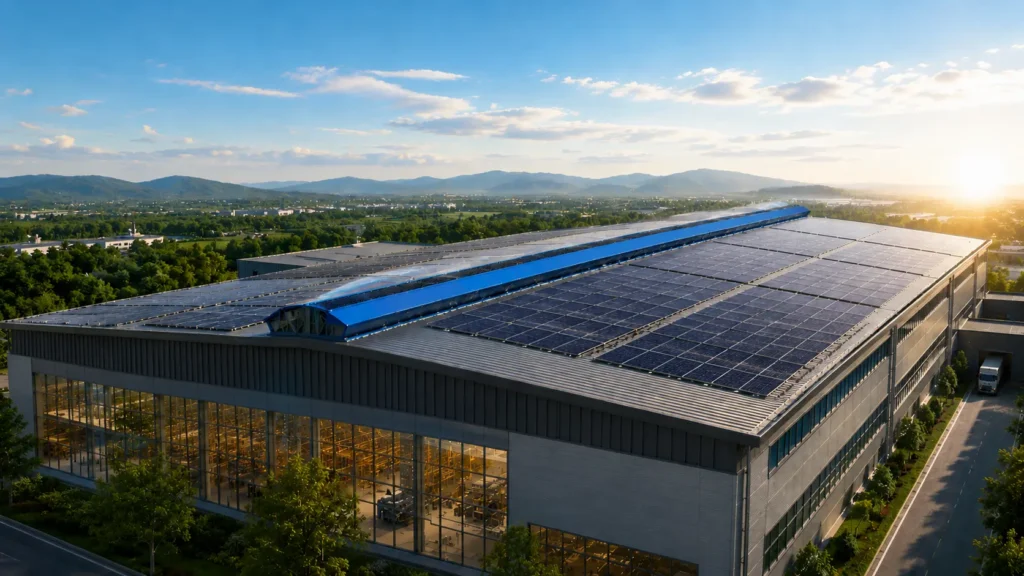
Every Indian industrial shed reaches a thermal tipping point between March and June. When the internal temperature at worker level crosses 38°C, productivity drops measurably — studies across South Asian manufacturing environments document 2–4% productivity loss per degree above this threshold. At 45°C, the Factories Act Section 13 mandates intervention. At 50°C, you have a workforce health and safety emergency.
Most plant managers respond to this problem in one of three ways: they install powered turbo ventilators, they run air conditioning they cannot afford, or they do nothing and absorb the productivity cost. All three responses share a common failure — they treat ventilation as a crisis response rather than an engineered building system.
The table above is based on a 10,000 sqm factory shed in Maharashtra. The ‘do nothing’ approach has the highest 10-year cost because it internalises productivity loss, elevated absenteeism, and increasing Factories Act compliance risk as hidden costs that never appear in a ventilation budget — but appear consistently in HR and production reports.
| Ventilation Approach | Installation Cost | Annual Operating Cost | 10-Year Total Cost |
| Do nothing | ₹0 | ₹1.2L–₹22L (productivity loss, legal risk) | ₹12L–₹2.2Cr |
| HVAC / air conditioning | ₹1.8L–₹4.5L & more | ₹1.4L–₹28L/year electricity | ₹15.8L–₹3.25Cr |
| Powered turbo ventilators | ₹3L–₹6L | ₹1.5L–₹3L/year (electricity + maintenance) | ₹18L–₹36L |
| GS passive ridge vent system | ~ ₹6L–₹12L | ₹0 — zero operating cost | ₹6L–₹12L install only |
| METAhybrid + ridge vent combo | UP to ₹20L–₹35L | ₹0 ventilation + Up to 30–40% HVAC saving | Lowest 10-yr total |
This guide is for factory owners, plant engineers, and EPC contractors who want to understand industrial ventilation as what it actually is: a permanent building infrastructure decision with a measurable return on investment and a clear IS standards compliance requirement. We will cover the full passive and active ventilation product range, the engineering decision logic for matching product to factory type, and the ROI calculations that make the specification case.
The Legal and Standards Framework: What Governs Factory Ventilation in India
Industrial ventilation in India sits at the intersection of structural engineering standards, energy codes, and labour law. Understanding all three is essential for any factory owner or plant engineer writing a ventilation specification — because the requirement is not discretionary.
Factories Act 1948 — Section 13: Ventilation and Temperature
Section 13 of the Factories Act 1948 is the primary statutory obligation for every factory registered under the Act. Sub-section 13(1) requires effective and suitable provision for adequate ventilation by the circulation of fresh air and for securing and maintaining a reasonable temperature. Sub-section 13(2) requires that measures are taken to protect workers where excessive heat is generated by any work process.
The Maharashtra Factories Rules 1963 (applicable in Maharashtra, where GS operates and where the majority of India’s sugar and chemical industries are concentrated) define ‘comfortable temperature’ as not exceeding 30°C at 1.5m above floor level in occupied work areas where the primary work is light or sedentary. For heavy manufacturing, the threshold is adjusted based on the work type but remains legally enforceable. A factory inspector finding internal temperatures consistently above 40°C without demonstrable ventilation provision can issue an improvement notice, stop the factory, or initiate prosecution.
NBC 2016 — Part 8, Section 1: Natural Lighting and Ventilation
The National Building Code 2016 specifies minimum ventilation opening areas for industrial buildings based on occupancy, floor area, and building height. For standard industrial sheds, the minimum natural ventilation opening is 5% of the floor area — meaning a 10,000 sqm factory requires a minimum of 500 sqm of effective ventilation opening. A continuous ridge vent running the full roof length typically provides 60–120 sqm of effective throat area per 100 running metres, depending on throat width. NBC 2016 compliance should be verified at design stage, not after construction.
IS 3792:1978 — Guide for Heat Insulation of Hot Surfaces in Industry
IS 3792 addresses thermal management in industrial structures where process equipment generates significant heat loads. It provides guidance on the interaction between building insulation, ventilation, and process heat — the three-variable system that determines internal factory temperature. The standard is particularly relevant for factories where process heat (furnaces, boilers, ovens, evaporators) contributes to the building’s thermal load alongside solar gain. Any ventilation specification for a process-heat-generating factory should reference IS 3792 in the design basis.
ECBC 2017 — Energy Conservation Building Code
The ECBC 2017 is mandatory for commercial buildings above 500 sqm in BEE-notified states. For industrial buildings, ECBC compliance is not yet universally mandated — but it is increasingly required for factories pursuing ISO 14001 environmental management certification, green building ratings (GRIHA / LEED), or export market sustainability compliance (particularly for textile and pharmaceutical manufacturers supplying EU / US markets). The METAhybrid + ridge vent combination addresses ECBC’s roof U-value requirements and ventilation provisions simultaneously.
IS 875 Part 3:2015 — Wind Loads on Buildings and Structures
All ventilation products installed in factory roofs must be structurally designed for the wind loads applicable to the building’s location and terrain category. IS 875 Part 3:2015 provides the wind pressure coefficients for all Indian wind zones. Ridge vents and turbo ventilators installed in Category 3 terrain (industrial/semi-urban zones) in Maharashtra must withstand design wind speeds of 33–39 m/s. All GS ventilation products are designed to IS 875 Part 3 Category 3 terrain — structural calculations and product certification available on request.
Passive vs Active Ventilation: The Engineering Decision Framework
The first design decision for any factory ventilation system is the same: passive or active? The answer is almost always passive first, active where passive is insufficient. Understanding why requires understanding how each system works and what governs its effectiveness.
How Passive Ventilation Works: Thermal Buoyancy and Wind Pressure
Passive ventilation in a factory shed operates on two driving forces: thermal buoyancy and wind pressure differential. Thermal buoyancy — also called the stack effect — occurs because hot air is less dense than cool air. In a factory with a significant heat load (process equipment, solar gain, worker activity), the hot air rises continuously toward the roof apex. A ridge vent at the apex provides the exhaust opening through which this hot air escapes, drawing cooler fresh air in through low-level openings (doors, louvres, side wall vents) to replace it.
Wind pressure differential adds a second driving force: wind creates a positive pressure on the windward side of a building and a negative pressure on the leeward side and at the roof apex. A well-designed ridge vent exploits this negative pressure zone — the hat-type cavity geometry of GS’s Hat-Top Ridge Vent creates a consistent low-pressure zone at the vent throat regardless of wind direction, enhancing exhaust airflow beyond what thermal buoyancy alone provides.
The critical insight: passive ventilation works continuously — 24 hours per day, 365 days per year — without electricity, without maintenance, and without failure modes. The only condition under which passive ventilation is insufficient is when the building’s heat load exceeds what the available ridge throat area and low-level openings can handle. This condition is calculable — and when it is met, the correct response is to increase the ridge throat width or add supplementary active ventilation, not to replace passive with active entirely.
When Active Ventilation Is Necessary
Active ventilation — powered fans, motor-driven turbo ventilators, or mechanical air handling — is the correct specification in a defined set of conditions:
- Enclosed or underground spaces where there is no roof ridge and no thermal stack path (basement workshops, below-grade service areas, tunnels)
- Boiler rooms and compressor houses where heat loads exceed what a passive system can exhaust even with maximum ridge throat area
- Cleanroom and pharmaceutical manufacturing where precise positive or negative air pressure control is required — passive systems cannot maintain differential pressure
- Spray booths, chemical process areas, and other spaces requiring forced exhaust of hazardous fumes per IS 5182 or OSHA-equivalent standards
- Spaces with no roof ridge access for a continuous vent — individual bays within larger structures, service rooms, and equipment housings
The engineering principle: design for passive first. Size the ridge vent to handle the calculated heat load. Use active ventilation only for the residual cases where passive geometry is inadequate. A factory that over-specifies active ventilation and under-specifies passive is paying electricity bills that a correct passive specification would eliminate.
Benefits of Industrial Ventilation Systems
A properly designed industrial ventilation system provides:
Lower Internal Temperatures
Reduces worker-level temperatures by 8–15°C.
Improved Productivity
Worker productivity decreases significantly above 38°C.
Reduced Energy Consumption
Cuts dependency on HVAC and evaporative cooling systems.
Better Air Quality
Removes dust, humidity, smoke, and fumes.
Regulatory Compliance
Supports compliance with Factories Act 1948 and NBC 2016.
Longer Roof Life
Reduces heat stress and condensation issues.
▌ THE COMPLETE GS VENTILATION RANGE — 8 PRODUCTS ACROSS PASSIVE AND ACTIVE
The GS Factory Ventilation Product Range: Matched to Factory Type
Geometric Steels manufactures eight ventilation products covering the full spectrum of passive and active industrial ventilation requirements. Each product is ISO 9001:2015 (IAF MLA) and CE certified, manufactured at Kurkumbh MIDC, Pune. The following product matrix maps each product to its primary factory application.
| GS Product | Type | New Build | Retrofit | Moving Parts | Opex | Primary Factory Application |
| Hat-Top Ridge Vent | Passive | Yes | No* | None | ₹0 | All factory types — new-build sheds |
| Monitor Ridge Vent | Passive | Yes | Yes | None | ₹0 | Existing factories replacing turbo vents |
| Onion Ridge Vent | Passive | Yes | Yes | None | ₹0 | Secondary sheds, stores, workshops |
| Apex Ridge Vent 3000mm | Passive | Yes | No* | None | ₹0 | Large-span sheds >40m — 3000mm throat, no competitor |
| GEO 24WINDY Turbo | Active | Yes | Yes | Impeller | Low | Boiler rooms, compressor houses, chemical stores |
| Commercial Turbo Vent | Active | Yes | Yes | Impeller | Low | Commercial buildings, retail, institutional roofs |
| Round Edge Louver Z-203 | Passive | Yes | Yes | None | ₹0 | Side wall fresh air intake — all factory types |
| Sand Trap Louver | Passive | Yes | Yes | None | ₹0 | Cement, mining, desert-region warehouses (Gujarat/RJ) |
* Monitor Ridge Vent is the retrofit product. Hat-Top and Apex Ridge Vents are optimised for new-build where the ridge can be left open during sheeting.
Hat-Top Ridge Vent — The Zero-Maintenance Continuous Passive Vent
The Hat-Top Ridge Vent is Geometric Steels’ flagship passive ventilation product and the only product of its type manufactured in India. Its dual-louvered hat-type cavity runs the full length of the roof ridge, creating a continuous exhaust channel for hot air, moisture, and fumes — without electricity, without bearings, and without a maintenance schedule. In 62+ industrial installations since 2007, zero mechanical failures have been recorded. The product is available in 300mm, 450mm, and 600mm throat widths and in 3m and 5m lengths.
Apex Ridge Vent — 3000mm Throat Width, Zero Competition in India
The Apex Ridge Vent is Geometric Steels’ specification for large-span industrial sheds — petrochemical facilities, aircraft hangars, large-format logistics warehouses, and power plant structures where spans exceed 40–50 metres and where a 600mm throat width is structurally or thermally insufficient. Available at throat widths from 900mm up to 3000mm — customisable — the Apex Ridge Vent has no direct competitor in India. No other Indian manufacturer produces a continuous passive ridge vent at this throat dimension. For NHAI, defence, PSU, and large EPC projects, the Apex Ridge Vent is the specification that places GS in a procurement category with zero competition.
Monitor Ridge Vent — The Retrofit Specialist
The Monitor Ridge Vent is engineered for one purpose: replacing turbo ventilators on existing factory roofs without a full re-roofing project. It installs directly over any existing roof profile — corrugated, trapezoidal, or standing seam — without structural modification. Available in 5m lengths that reduce installation joints by 40% compared to standard 3m units, the Monitor Ridge Vent converts a powered maintenance burden into a passive, permanent installation in 3–5 days per 100-metre shed during a planned shutdown.
GEO 24WINDY Turbo Ventilator — Active Ventilation Engineered for Harsh Environments
Where passive ventilation is insufficient — typically boiler rooms, compressor houses, and chemical storage areas — the GEO 24WINDY is the GS active ventilation solution. Its defining engineering feature is a fully sealed bearing housing with specific protection against the airborne contaminants that destroy standard turbo ventilator bearings in industrial environments: dust, chemical fumes, bagasse fibre, and high humidity. The 600mm variable-angle elbow adjustment allows optimisation for low-wind-speed enclosed spaces where standard fixed-elbow ventilators perform poorly.
Round Edge Louver Z-203 — The Air Intake Partner to Every Ridge Vent
A ridge vent can only exhaust as much air as enters through the building’s low-level openings. The Round Edge Louver Z-203 is the GS fresh-air intake product — installed in side walls at low level to provide the intake airflow that the passive ridge vent system requires. Its round-edge blade design — exclusive to GS in India — reduces turbulence noise and distributes stress evenly across the blade profile, eliminating the blade-tip cracking that occurs in sharp-edge louvers after years of wind cycling. Available up to 12m length — no competitor offers this dimension.
Ventilation Specification by Factory Type: The Right Product for Your Industry
Different industrial verticals have different heat load profiles, different contaminant types, and different regulatory requirements. The correct ventilation specification varies accordingly. Here is the GS recommended system for ten major Indian industrial factory types.
| Factory Type | Primary Heat/Contaminant | GS Recommended System | Key Specification Note |
| Sugar / Jaggery Factory | Process heat 50–65°C + bagasse dust + sulfur | Hat-Top Ridge Vent + Louvers + METAhybrid | PPGL Al-Zinc for sulfur resistance; 62+ installations since 2007 |
| Textile Mill | High humidity + fine fibre + heat | Hat-Top or Monitor + Sand Trap Louvers | Sand Trap Louver C-blade prevents fibre entry into air intake |
| Cement / Mining Plant | Heavy particulate + heat + corrosive dust | Apex Ridge Vent + Sand Trap Louver | Large throat width for high heat load; sand trap intake essential |
| Pharmaceutical Manufacturing | Controlled environment + cleanroom zones | METAhybrid + Louvers + monitored active | METAhybrid Class O fire rating meets pharma facility fire NOC conditions |
| Food Processing Plant | Steam + humidity + hygiene requirement | Hat-Top Ridge Vent + METAhybrid Dbl Skin | Double skin vapour barrier prevents condensation on inner roof surface |
| Automobile / Auto-Ancillary | Paint fumes + heat + chemical vapour | GEO 24WINDY + Ridge Vent (zones) | Active for spray booth; passive ridge vent for assembly and storage zones |
| Warehouse / Logistics Hub | Solar gain — no process heat | Hat-Top or Monitor + Louvers | Pure solar gain load — passive system is fully sufficient in most cases |
| Steel / Metal Fabrication | Extreme process heat + welding fume | Apex Ridge Vent (large throat) + GEO 24WINDY | Large throat width for extreme heat load; active at welding bays |
| Chemical / Pharma Storage | Vapour + temperature control requirement | GEO 24WINDY + passive ridge vent combo | Active ensures forced exhaust of vapour; passive for general heat removal |
| Cold Chain / Refrigeration | Condensation + insulation requirement | METAhybrid Double Skin + controlled louvers | Vapour barrier and high R-value critical; no ridge vent required |
Ridge Vent vs Turbo Ventilator
| Feature | Ridge Vent | Turbo Ventilator |
|---|---|---|
| Electricity | No | Yes |
| Maintenance | Very Low | Medium |
| Lifespan | 20+ Years | 5–10 Years |
| Operating Cost | Zero | Continuous |
| Airflow Coverage | Continuous | Point Based |
How to Calculate Your Factory’s Ventilation Requirement: The Engineering Method
The correct passive ridge vent specification for a factory is determined by a ventilation load calculation — not by rule of thumb or by copying the nearest competitor’s installation. Here is the method used by GS’s technical team for every factory ventilation project:
Step 1 — Calculate the Total Sensible Heat Load (Q)
The total sensible heat load (Q, in watts) is the sum of three components:
- Solar heat gain through roof: Q_solar = roof area (sqm) × solar heat flux (W/m²) × roof solar absorptance. For a dark-coloured metal roof in Maharashtra, peak solar heat flux is approximately 900 W/m² and solar absorptance is 0.85–0.90 for standard colours. Example: 10,000 sqm × 900 × 0.87 = 7.83 MW peak solar gain.
- Process heat load: from equipment manufacturers’ data sheets or measured from existing installations. Sugar factory evaporators: 8–12 MW per 2,500 TCD. Textile mill: 200–500 kW per 1,000 sqm. Warehouse (no process): 0 kW process heat.
- Occupancy heat load: number of workers × 90W per person (light work) or 180W per person (heavy work). Usually minor vs solar and process contributions.
Step 2 — Determine the Required Exhaust Volume (V)
Required ventilation volume (V, in m³/s) = Q_total ÷ (ρ × Cp × ΔT), where ρ = air density (1.2 kg/m³), Cp = specific heat of air (1,005 J/kg·K), and ΔT = acceptable temperature rise (typically 10–15°C for standard factories, 5–8°C for worker-intensive operations). For a 10,000 sqm warehouse with Q_total = 7.83 MW and ΔT = 12°C: V = 7,830,000 ÷ (1.2 × 1,005 × 12) = 540 m³/s required exhaust capacity.
Step 3 — Size the Ridge Vent Throat
Effective exhaust velocity through a passive ridge vent is approximately 0.8–1.5 m/s under combined thermal buoyancy and wind pressure driving forces for a well-designed factory shed. Required throat area (A) = V ÷ exhaust velocity = 540 ÷ 1.1 = 491 m² for the warehouse example. For a 100m ridge length with 600mm throat Hat-Top Ridge Vent: effective throat area = 100m × 0.6m = 60 m² per side × 2 sides = 120 m². Conclusion: a single Hat-Top Ridge Vent at 600mm throat is insufficient for this heat load — an Apex Ridge Vent at 1,500mm throat or multiple parallel ridge vent runs would be required. This is the calculation that drives the product selection — not visual estimation.
Geometric Steels provides this complete ventilation load calculation for every factory project at no charge. Send us your building dimensions, roof plan, process equipment list with heat outputs, and occupancy data. We return a complete ventilation specification within 48 hours — including ridge vent throat width, linear meterage, low-level intake louver sizing, and a confirmation that the specification meets NBC 2016 and Factories Act Section 13 requirements.
Industrial Ventilation System Cost in India
The cost of an industrial ventilation system depends on:
- Factory size
- Heat load
- Ventilation type
- Building height
- Industry sector
Typical cost ranges:
| Factory Size | Estimated Cost |
|---|---|
| 5,000 sqm | ₹3.5L–₹6.5L |
| 10,000 sqm | ₹6L–₹12L |
| 15,000 sqm | ₹12L–₹20L |
| 25,000 sqm+ | Custom Design |
ROI Calculations: The Financial Case for Passive Ventilation Across Three Factory Types
Factory A — 5,000 sqm Textile Mill, Surat
| Cost Factor | Value |
| Current: 20 powered turbo vents + evap. cooling | ₹1.8L/year electricity + ₹60K maintenance |
| Proposed: GS passive ridge vent system | ~₹5.5L install, ₹0/year operating |
| Annual saving (electricity + maintenance) | ~₹2.4L per year |
| Payback period | 2.3 years |
| 10-year net saving | ₹Up to 18.5L |
Factory B — 15,000 sqm Pharmaceutical Manufacturing Facility, Hyderabad
| Cost Factor | Value |
| Current: HVAC running against bare metal roof | ₹Up to 28L/year electricity |
| Proposed: METAhybrid Double Skin (15,000 sqm) | ₹Up to 42L install, ₹0 ventilation opex |
| Annual HVAC saving (Up to 30% load reduction) | ~ ₹8.4L/year |
| Payback period | 5.0 years |
| 10-year net saving | ₹Up to 42L |
Factory C — 8,000 sqm Warehouse, Delhi NCR Logistics Park
| Cost Factor | Value |
| Current: No ventilation — ambient internal temp | 48–52°C in May-June; stock damage, productivity loss |
| Proposed: Hat-Top Ridge Vent + Round Edge Louvers | ₹7.2L install, ₹0 operating |
| Internal temp. reduction at worker level | 10–14°C reduction |
| Productivity recovery (4% × ₹45L/yr payroll) | ₹1.8L/year productivity gain |
| Stock damage / spoilage saving | ₹1.2L–₹2.4L/year (product-specific) |
| Payback period | 2.4–2.9 years |
| 10-year net saving | Up to ₹23L–₹30L |
Where GS Ventilation Systems Are in Service
62+ Sugar and Agro-Processing Factories — Maharashtra, UP, Karnataka & More.
The most concentrated proof base for GS passive ventilation is the sugar factory vertical. 62+ Hat-Top Ridge Vent installations across Maharashtra’s and india sugar belt — Kolhapur, Sangli, Solapur, Satara, Nashik, Pune, UP — have been in continuous service since 2007 with zero maintenance callouts. This vertical deployment across one of India’s most aggressive industrial environments (50–65°C, high humidity, bagasse dust, sulfurous atmosphere) is the field evidence that no laboratory test can replicate.
Industrial Ventilation Solutions Across India
Geometric Steels supplies industrial ventilation systems across India including:
Maharashtra
Sugar Factories, Warehouses, Engineering Plants
Gujarat
Chemical Plants, Cement Facilities
Karnataka
Food Processing and Manufacturing
Uttar Pradesh
Sugar Mills and Industrial Parks
Telangana
Pharmaceutical Manufacturing
Rajasthan
Mining and Cement Industries
Tamil Nadu
Textile Manufacturing Facilities
Madhya Pradesh
Warehouses and Agro Industries
Tanzania Sugar Factory- An Internation, and the biggest of all time!
Samruddhi Mahamarg — 701 km, Maharashtra
India’s longest greenfield expressway specified Geometric Steels roofing and ventilation products for its toll plaza and service infrastructure across the full 701 km corridor. The scale and duration of this project — spanning Vidarbha, Marathwada, and Konkan climate zones — required ventilation products that performed consistently across extreme temperature variations (sub-10°C winter to 47°C summer) with zero in-service maintenance. The passive ridge vent system met this requirement.
Z-Morh Tunnel, Ladakh — 11,500 Feet
The Z-Morh Tunnel project at 11,500 feet altitude in Ladakh proves performance at the extreme end of the Indian climate envelope — sub-zero temperatures, high-altitude UV exposure, and seismic zone IV loading. GS products installed at this altitude are operating in conditions that disqualify most industrial building components. For defence, BRO, and mountain infrastructure projects where product reliability under extreme environmental stress is a procurement requirement, Z-Morh is the reference that establishes GS’s credentials.
Philippines Metro — International Infrastructure
GS ventilation and structural products have been exported to the Philippines Metro transit project — qualifying under international CE certification standards reviewed by the project’s independent structural consultants. This international deployment confirms that GS products compete on equal technical terms with European and Australian manufacturers in international infrastructure procurement. For Indian EPC contractors pursuing international projects, GS’s CE marking and IAF-accredited ISO certification are the credentials that make overseas specification possible.
Frequently Asked Questions
Q1: What is the best ventilation system for an industrial factory in India?
The best system depends on three factors: the factory’s heat load (solar gain + process heat), the building geometry (span, height, ridge length), and the contaminant type (dust, fumes, moisture, or simply heat). For most standard industrial sheds with no aggressive chemical process, a continuous passive ridge vent — Hat-Top or Monitor depending on whether the project is new-build or retrofit — is the correct specification. It requires no electricity, no maintenance, and provides continuous ventilation regardless of power availability. Where process heat loads are extreme (boiler rooms, compressor houses) or where contaminant control requires forced exhaust, the GEO 24WINDY turbo ventilator supplements the passive system.
Q2: How much does a factory ventilation system cost in India?
Cost depends on factory size, product specification, and installation complexity. As a reference range: a passive ridge vent system for a 5,000 sqm factory shed typically costs ₹3.5L–₹6.5L for supply and installation, with zero operating cost thereafter. A powered turbo ventilator system for the same shed costs ₹1.5L–₹2.5L to install but ₹80,000–₹1.5L per year in electricity and maintenance — making the passive system cheaper within 3–5 years. Geometric Steels provides a complete project-specific cost estimate and ROI comparison for any factory project — contact us with building dimensions and location.
Q3: Is a ridge vent effective in zero-wind conditions?
Yes — a continuous ridge vent operates on two driving forces: wind pressure differential and thermal buoyancy (stack effect). During zero-wind conditions, the thermal buoyancy driving force remains active as long as there is a temperature differential between internal factory air and external ambient air. In Indian industrial environments, this differential is present for essentially all operating hours. The hat-type cavity geometry of GS’s ridge vent enhances both effects — it does not depend on wind alone.
Q4: What Factories Act requirements apply to industrial ventilation in Maharashtra?
Factories Act 1948 Section 13 mandates adequate ventilation and temperature control in all registered factories. The Maharashtra Factories Rules 1963 specify comfortable temperature thresholds (30°C at 1.5m above floor for light work) and require that factory managers take measures to reduce excessive heat. Factory inspectors conduct periodic inspections under these provisions. Non-compliance can result in improvement notices, production stoppages, or prosecution. Geometric Steels provides a Factories Act Section 13 compliance statement — confirming the ventilation system meets the Act’s provisions — as standard documentation with every project supply.
Q5: How many ridge vents does a 10,000 sqm factory need?
The correct answer requires a ventilation load calculation — not a rule of thumb. Variables include: roof area, building height, solar heat flux for the location, process heat load, and acceptable internal temperature rise. As a general reference: a 10,000 sqm warehouse (pure solar load, no process heat) in Maharashtra typically requires a continuous Hat-Top Ridge Vent at 600mm throat width running the full ridge length (80–100 running metres) plus matching side wall louver area of 400–600 sqm. Contact Geometric Steels with your building dimensions for a full calculation — provided free as part of our BOQ service.
Q6: What is the difference between a ridge vent and a turbo ventilator?
A ridge vent is a passive, continuous ventilation system running the full length of the roof ridge with no moving parts. A turbo ventilator is a point-source, wind-driven rotating device installed at intervals across the roof. Ridge vents ventilate uniformly along the full ridge length; turbo ventilators ventilate only the area immediately below each unit. Ridge vents require zero maintenance; turbo ventilators require bearing replacement every 12–18 months in standard industrial environments (shorter in aggressive environments like sugar factories). Ridge vents continue operating in zero-wind conditions via thermal buoyancy; turbo ventilators stop rotating and provide no ventilation when wind speed drops to zero.
Free Ventilation Load Calculation for Your Factory — 48-Hour Turnaround
After 20 years designing and manufacturing ventilation systems for factories across India — from sugar mills in Kolhapur to warehouses in Delhi NCR to infrastructure projects in Ladakh — we have one standard offer: give us your factory dimensions and heat load, and we will give you the engineering specification that eliminates the guesswork, meets the IS standards, and delivers a system that runs at zero operating cost for the life of your building.
We provide:
- Free ventilation load calculation — IS 3792 and NBC 2016 methodology
- Product selection across the full GS range: Hat-Top, Monitor, Apex, Onion, GEO 24WINDY, Louvers
- Complete BOQ with product specifications, quantities, and pricing
- IS 875 Part 3 wind load compliance documentation
- Factories Act Section 13 compliance statement for your legal file
- 10-year ROI comparison: GS passive system vs your current specification
- ISO 9001:2015 (IAF MLA) and CE certification documents
- Reference contacts at operating factories in your industry vertical and state
Need a Free Factory Ventilation Design?
Our engineering team will calculate:
✓ Heat Load
✓ Airflow Requirement
✓ Ridge Vent Sizing
✓ Louver Requirement
✓ NBC 2016 Compliance
✓ ROI Projection
For More Visit Here: https://geometricsteels.com/factory-ventilation-systems/
Send your factory drawings and receive a complete ventilation design proposal within 48 hours.
Contact Geometric Steels Roll Forming Pvt. Ltd.
Phone: +91 8550995556 | geometricsteels.com
Manufacturing: Kurkumbh MIDC, Pune, Maharashtra
Ventilation systems in service across Maharashtra · Gujarat · Delhi NCR · UP · Karnataka · Philippines · Tanzania
ISO 9001:2015 (IAF MLA) | CE Marked | Established 2006
India Builds Under Our Roof. | 20 Years · 64 Products · 7 Countries · ISO · CE · IAF Certified