Looking for a trusted hat-top ridge vent supplier? Geometric Steels’ passive ventilation system runs in 62+ Indian factories with zero maintenance since 2007. Get a free BOQ for Hat-Top Passive Ventilator from Top Ridge Vent Manufacturer India
16th May 2026, Reding time: 10Mins
Hat-Top Ridge Vent Manufacturer India: High-Performance Passive Ventilation for Industrial Sheds
The Problem No One Calculates Until It’s Too Late!
Every summer, between March and June, the internal temperature of a typical industrial shed in Maharashtra crosses 48°C to 55°C. For a sugar factory operating at full crush, the challenge is compounded, processing generates heat, moisture, and particulate matter simultaneously, while your roof traps all three.
Most plant managers respond with powered turbo ventilators. The decision appears logical until you calculate its true cost:
| Cost / Performance Factor | Powered Turbo Ventilator | Hat-Top Ridge Vent (GS) |
| Electricity Consumption | ₹4,800–₹8,400/month per unit | ₹0 — passive operation |
| Bearing Failure Rate | 12–18 months avg. lifespan | Zero moving parts |
| Roof Access for Maintenance | Every 6–12 months | Not required |
| Performance in Power Outage | Zero — stops working | 100% — continues 24/7 |
| 10-Year Total Cost (10 units) | ₹6L–₹10L + replacement costs | Installation cost only |
The Hat-Top Ridge Vent has been operational in 62+ sugar and jaggery factories across Maharashtra, Uttar Pradesh, and Karnataka since 2007. In 18 years of documented field performance, Geometric Steels has recorded zero maintenance calls attributable to product failure.
What Is a Hat-Top Ridge Vent?
The Engineering Explained!
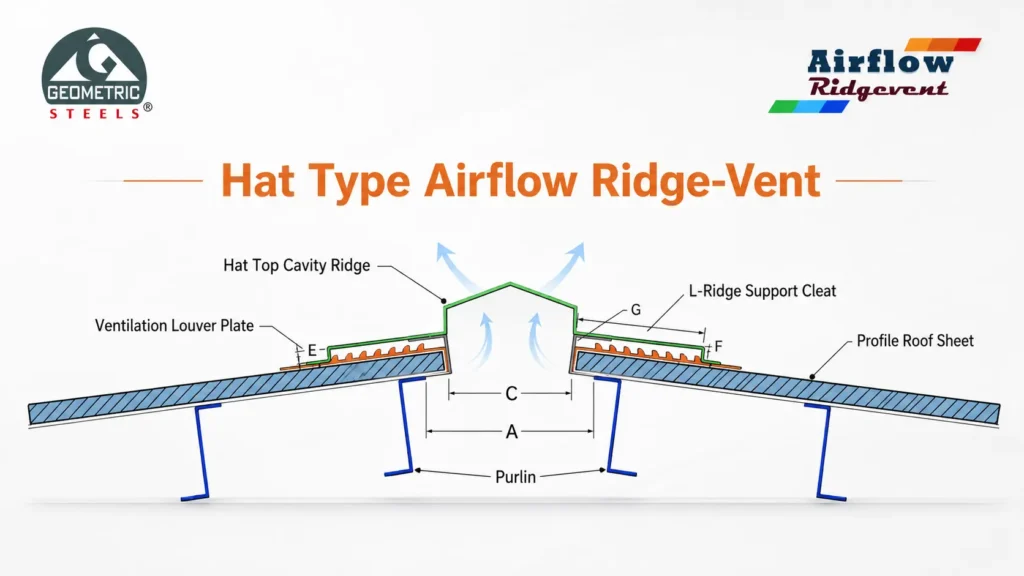
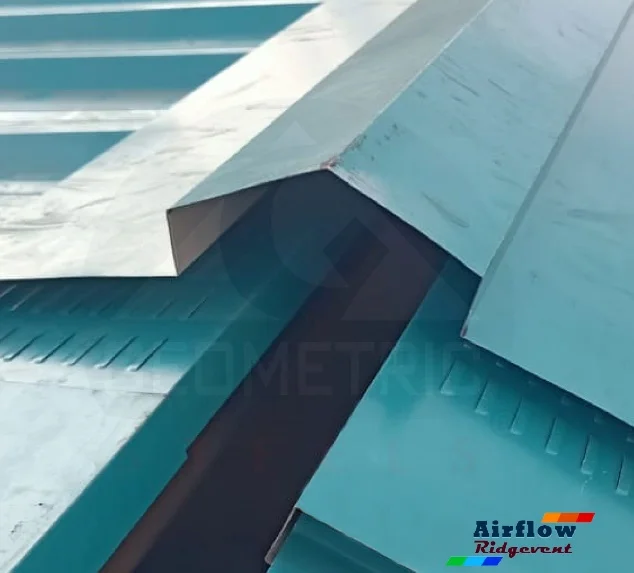
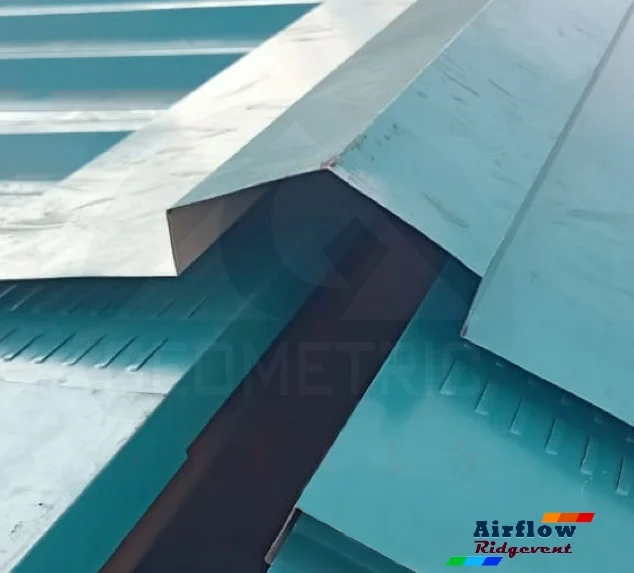
A Hat-Top Ridge Vent — also marketed as the Airflow Hat Top Ridgevent — is a passive, continuous ventilation system installed at the ridge (apex) of an industrial roof. Unlike a turbo ventilator, which is a point-source rotating device, the Hat-Top Ridge Vent runs the full length of the roof ridge, creating a continuous exhaust channel for hot, stale, and moisture-laden air.
The defining characteristic of the Geometric Steels system is its dual-louvered, hat-type cavity profile:
- Thermal Buoyancy: The hat-shaped cavity creates a continuous low-pressure zone at the roof ridge, powered entirely by the natural thermal buoyancy of hot air rising from the factory floor.
- Counter-Directional Exhaust: Two sets of counter-directional exhaust louvers situated on opposing sides of the cavity allow indoor air to exit freely, completely independent of external wind velocity or direction.
- Weatherproofing: The internal cavity geometry is engineered so that wind-driven rain, even at aggressive angles up to 45° (tested as per IS 875 Part 3 wind load requirements), cannot penetrate the vent chamber—eliminating the primary leak concern raised by structural contractors.
- Aesthetic Integration: Fabricated from premium pre-painted galvanized or galvalume steel (PPGI/PPGL), the profile remains visually invisible from ground level, featuring no protruding mechanical cowls or spinning caps.
Engineering note: The hat-type cavity profile is proprietary to Geometric Steels. No other Indian manufacturer produces a continuous passive ridge vent with this specific dual-louvered cavity geometry. This product has no direct competition in the Indian market.
Applicable IS Standards and Certification Requirements
For procurement heads, MEP consultants, and structural engineers specifying ventilation for industrial and food-processing facilities, understanding the relevant code framework is non-negotiable.
IS 3792:1978 — Guide for Heat Insulation of Hot and Cold Surfaces
Covers thermal management requirements for industrial structures, including factory roofing systems. The Hat-Top Ridge Vent satisfies the passive ventilation provisions of this standard by ensuring continuous hot-air removal before it can transfer to structural members.
IS 875 Part 3:2015 — Wind Loads on Buildings and Structures
All GS ridge vents are designed and tested to IS 875 Part 3:2015 wind pressure coefficients for Category 3 terrain (industrial zones). The hat cavity geometry ensures that the vent maintains structural integrity at wind speeds up to 39 m/s, covering all non-cyclonic industrial zones across India.
ISO 9001:2015 — Quality Management System
Geometric Steels Roll Forming Pvt. Ltd. is ISO 9001:2015 certified. Every Hat-Top Ridge Vent unit leaving the Kurkumbh MIDC, Pune facility passes multi-stage quality inspection: raw material incoming inspection, in-process dimensional verification, coating adhesion testing, and final waterproofing certification.
CE Marking — EN Standards for Industrial Ventilation Products
Geometric Steels holds CE marking for applicable products in the ventilation category. CE certification is the governing quality standard for export markets (Geometric Steels currently exports to 7 countries) and is increasingly specified by Indian EPC contractors and PSUs for infrastructure projects requiring international compliance documentation.
IAF MLA Accreditation
The ISO certification held by Geometric Steels is accredited under the IAF (International Accreditation Forum) Multilateral Recognition Arrangement — meaning it is recognised in all 104 IAF member economies. For government tender specifications (CPWD, NHAI, PSU procurement), IAF-accredited ISO certification is the gating requirement. Geometric Steels’ certification meets this standard.
The ROI Calculation: What Passive Ventilation Actually Saves
The decision to specify a Hat-Top Ridge Vent over powered turbo ventilators is, at its core, a financial engineering decision. Here is the calculation as it applies to a mid-sized sugar factory with a 10,000 sqm (100m × 100m) crushing hall:
Scenario: 10,000 sqm Crushing Hall, Maharashtra Sugar Belt
Typical powered turbo ventilator specification for this footprint: 20 units of 600mm diameter turbo ventilators. Power consumption per unit: approximately 0.15 kW (motor-driven models). Running hours per year: ~4,000 hours (October–March crush season, plus year-round partial operation).
| Cost Element | Annual Cost (20 Turbo Units) |
| Electricity (0.15kW × 20 units × 4,000 hrs × ₹8/unit) | ₹96,000 per year |
| Bearing Replacement (avg. 8 units/year × ₹2,400 per set) | ₹19,200 per year |
| Roof Access Crew for Maintenance (4 visits × ₹8,000) | ₹32,000 per year |
| Total Annual Operating Cost | ₹1,47,200 per year |
| Hat-Top Ridge Vent Annual Operating Cost | ₹0 (zero electricity, zero moving parts) |
| 10-Year Savings by Switching to Hat-Top | ₹14,72,000 minimum (excluding downtime) |
This calculation excludes the cost of production downtime during roof-access maintenance events — typically 4–6 hours per visit in a live crushing facility, with associated production loss valued at ₹15,000–₹40,000 per incident depending on processing throughput. Including downtime, the 10-year saving frequently exceeds ₹20 lakhs for a facility of this scale.
Field Evidence: Why 62+ Sugar Factories Chose This Vent
Between 2007 and 2026, Geometric Steels has installed Hat-Top Ridge Vents in over 62 sugar, jaggery, and distillery facilities across the Maharashtra sugar belt — spanning the Kolhapur, Solapur, Sangli, Nashik, and Pune districts — as well as facilities in Uttar Pradesh and Karnataka.
The adoption pattern in this vertical is instructive: the first installation in a district typically comes from direct technical specification. Every subsequent installation in that district has come from peer referral — factory managers visiting other facilities during the crushing season, seeing the vent in operation, and specifying it for their own expansion or renovation projects.
Documented Performance in Extreme Conditions
Sugar crushing generates operating conditions that test any ventilation product severely: sustained internal temperatures of 50–65°C at roof level, high relative humidity (frequently exceeding 80%), fine particulate matter from bagasse handling, and corrosive sulfur compounds from molasses processing. The Hat-Top Ridge Vent’s colour-coated galvalume construction — using Al-Zinc alloy coating at 150–180 g/m² — is rated for continuous exposure to these conditions without coating failure.
Tanzania Export Installation
Geometric Steels’ ventilation products have been specified for industrial facilities in Tanzania — one of 7 export markets where GS products are in commercial service. This international deployment confirms that the product’s performance characteristics hold across equatorial conditions, including sustained ambient temperatures above 35°C and high humidity environments comparable to coastal Indian conditions.
When evaluating a ridge vent for your sugar factory, ask your supplier for: (1) the number of existing sugar factory installations, (2) reference contacts at those facilities, (3) CE and ISO certification documents. These three questions separate vendors from manufacturers.
| Parameter | Specification Standard & Performance Metric |
| Vent Type | Continuous passive ridge vent, hat-type cavity profile |
| Construction Material | PPGI / PPGL (Pre-painted galvanise / galvalume), Al-Zinc alloy coating |
| Coating Standard | IS 14246 / IS 3034 compliant colour coating; corrosion resistance to IS 1573 standards |
| Available Throat Widths | 300mm, 450mm, 600mm (custom widths on request) |
| Standard Lengths | 3m and 5m (5m reduces installation joints by 40%) |
| Installation Compatibility | All standard roofing profiles: corrugated, trapezoidal, Ribstrong, BIGspan, standing seam |
| Operating Power Required | None — 100% passive thermal-buoyancy driven |
| Moving Parts | None |
| Maintenance Schedule | None required under normal industrial conditions |
| Rain Penetration Resistance | Tested to IS 875 Part 3 wind-driven rain criteria; no penetration at 45° wind angle |
| Thermal Range | Operating: -15°C to +85°C continuous; coating rated to -20°C |
| Certifications | ISO 9001:2015 (IAF MLA) | CE Marked | Manufactured at Kurkumbh MIDC, Pune |
| Proven Service Life | 18+ years documented field performance (first installation: 2007) |
Installation: What Your Structural Team Needs to Know
The Hat-Top Ridge Vent is a pre-assembled unit — it arrives at site as a complete, factory-finished component ready for roof installation. No on-site fabrication is required. The installation sequence for a standard new-build industrial roof:
- Structural purlins and roofing sheets are installed in standard sequence.
- The ridge cap — the top-most sheet at the apex — is left uninstalled.
- The Hat-Top Ridge Vent units are placed along the full length of the ridge, with each unit lapping the adjacent unit by 150mm.
- Standard GI hex-head self-drilling screws fasten the vent to the top purlin. No specialist tools required.
- Geometric Steels supplies matching colour-coated closure strips for the end caps of each ridge run.
For retrofit installations on existing buildings — where a turbo ventilator is being replaced — the GS Monitor Ridge Vent is the recommended product (it retrofits onto any existing roof profile without structural modification). The Hat-Top Ridge Vent is optimised for new-build or full roof replacement projects.
Frequently Asked Questions!
Q1: What is the difference between a hat-top ridge vent and a turbo ventilator?
A turbo ventilator is a point-source, wind-driven rotating device. It ventilates only the area directly beneath it, requires bearings that fail every 12–18 months, and stops functioning entirely in zero-wind conditions. A hat-top ridge vent is a continuous passive system running the full roof ridge, driven by thermal buoyancy (hot air rising). It operates 24 hours per day regardless of wind speed or electricity supply, requires no maintenance, and ventilates the full building length uniformly.
Q2: How many hat-top ridge vents does a 10,000 sqm sugar factory need?
Ventilation requirement is calculated based on internal heat load, building height, and required air changes per hour. For a standard crushing-hall shed of 10,000 sqm with a ridge height of 8–10 metres, a continuous Hat-Top Ridge Vent at 600mm throat width running the full ridge length (typically 100–120 running metres) is the standard specification. Our technical team provides free ventilation calculations and BOQ estimates for any project size — contact us with your building dimensions and process heat load.
Q3: Does the hat-top ridge vent leak in the monsoon?
This is the most common objection raised during specification. The hat-type cavity is designed so that rain driven at angles up to 45° cannot penetrate the inner vent chamber — tested to IS 875 Part 3 wind-driven rain criteria. In 62+ sugar factory installations across Maharashtra (where monsoon rainfall intensity reaches 150mm/day in the Western Ghats belt), zero rain penetration incidents have been recorded. The key design element is the counter-directional exhaust louvers, which face away from the prevailing wind and create a negative pressure zone inside the cavity.
Q4: What is the price of a hat-top ridge vent in India?
Pricing depends on throat width (300mm / 450mm / 600mm), material specification (PPGI vs PPGL), coating colour, and project quantity. Geometric Steels does not publish standard retail prices for industrial B2B products — pricing is always project-specific and includes a technical consultation. Contact our team with your building specifications for a complete BOQ and price estimate within 48 hours.
Q5: Can the hat-top ridge vent be installed on an existing factory roof?
Yes, with an important qualification. The Hat-Top Ridge Vent is optimised for new-build roofs where the ridge can be left open during sheeting. For existing roofs where the ridge is already closed and a turbo ventilator needs to be replaced, we recommend the Monitor Ridge Vent — which retrofits directly onto any existing roof profile without structural modification. Our site team can assess your existing roof and recommend the appropriate retrofit approach.
Q6: Which IS standard applies to industrial passive ventilation systems in India?
The primary applicable standards are IS 3792:1978 (Guide for Heat Insulation of Industrial Structures), NBC 2016 Part 8 Section 1 (Lighting and Ventilation), and IS 875 Part 3:2015 (Wind Loads). For food-processing facilities including sugar factories, FSSAI guidelines for facility ventilation also apply. Geometric Steels’ technical team can provide standard compliance documentation for tender submissions.
Why the Engineer’s Intelligence Chooses the Hat-Top Ridge Vent
The industrial procurement decision is rarely made on the cheapest option. It is made on the lowest total cost of ownership over the asset’s useful life.
For a building with a 25-year design life, the ventilation system’s operating cost dwarfs its installation cost.
| Feature / Standard | Hat-Top Ridge Vent (GS) | Powered Turbo Ventilator | Onion Ridge Vent |
| Electricity Required | None | Yes — ongoing | None |
| Moving Parts / Bearings | None | Yes — 12–18 months | None |
| Ventilation Coverage | Continuous — full ridge | Point-source only | Continuous — full ridge |
| Rain Resistance (IS 875 Part 3) | Tested and certified | Varies by manufacturer | Good |
| Sugar Factory Proven | 62+ factories, 20 years | Common, but with opex | Yes |
| Geometry for Large Spans | Up to 600mm throat width | Standard | 300–600mm |
| Available from GS | Yes — CE, ISO, IAF certified | Yes (GEO 24WINDY model) | Yes — since 2007 |
The Technical Consultation — No Obligation. Just Engineering Honesty.
If your factory’s ventilation specification demands the performance standard used in 62+ Indian sugar facilities — tested at 55°C, zero maintenance, 18-year field-proven — our technical team would like to show you exactly what that looks like on your building.
We provide:
- Free ventilation load calculation for your building dimensions
- Complete BOQ preparation — materials, quantities, specifications
- IS standard compliance documentation for your tender submission
- Reference contacts at existing sugar factory installations in your district
- Technical datasheet and installation guide for your structural team
Disclaimer: all the data and Informations are subjective and not intended to make specific claims about any scenarios take it as just supportive text to share the information.
For More Visit Here: https://geometricsteels.com/factory-ventilation-systems/
Contact Geometric Steels Roll Forming Pvt. Ltd.
Phone: +91 8550995556 | geometricsteels.com
Manufacturing: Kurkumbh MIDC, Pune, Maharashtra
ISO 9001:2015 (IAF) | CE Marked | Established 2007