A complete guide to Z purlin specification for EPCs and engineers. Explore Z vs. C purlins, IS standards, and Geometric Steels’ unique 80mm web height.
Word Count: ~2,700 words | Reading Time: ~11 minutes
The Purlin Decision Everyone Treats as a Commodity — and Shouldn’t
Z purlins are one of the most specified, least scrutinised components in industrial steel construction. They appear on almost every structural drawing for a shed, warehouse, or PEB structure, and in most projects they are procured on price alone from whichever local roll-forming unit can deliver on time. This works, most of the time — until it doesn’t.
The problems that arise from an under-specified or poorly manufactured purlin rarely show up at handover. They show up years later: excessive deflection under wind uplift, coating failure at bolted connections, or a structural engineer discovering that the available web height range from the local supplier does not match what the design actually called for — forcing an over-specification that adds unnecessary steel tonnage and cost.
This blog is written for structural engineers, EPC contractors, and procurement heads who want to treat Z purlin specification as the structural decision it actually is: what to verify from any manufacturer, what the relevant Indian standards require, and what Geometric Steels can offer that most local roll-forming suppliers cannot — including an 80mm web height option that fills a genuine gap in the commonly available range.
All technical specifications, dimensions, load capacities, and pricing indications referenced in this blog are indicative. Structural design values must be confirmed by a qualified structural engineer based on project-specific loading, span, and code requirements. Final product specifications are confirmed by Geometric Steels at the project quotation stage.
What Is a Z Purlin and Where Is It Used?
A Z purlin is a cold-formed steel structural section, shaped like the letter Z, used as a secondary structural member in roof and wall systems. It spans between primary structural members — rafters, trusses, or portal frame frames — and provides the direct support for the roofing sheet, insulated panel, or wall cladding fixed to it.
The Z profile geometry allows adjacent purlin sections to overlap at the primary support points, creating continuous beam action across multiple spans when correctly lapped and bolted. This is the key structural advantage of the Z profile over the alternative C (channel) profile — the Z shape permits nesting and lapping in a way that a C section’s symmetric geometry does not allow in the same manner.
Typical Applications
- Roof and wall secondary structure for pre-engineered buildings (PEB) and conventional steel-framed sheds
- Industrial warehouses, factory buildings, and logistics facilities
- Agricultural and agro-processing structures, including sugar factory sheds
- Commercial and institutional single-storey steel-framed buildings
- Mezzanine floor support in combination with composite steel decking
- Canopies, covered walkways, and secondary steel structures of varying scale
Z Purlin vs C Purlin: The Structural Difference
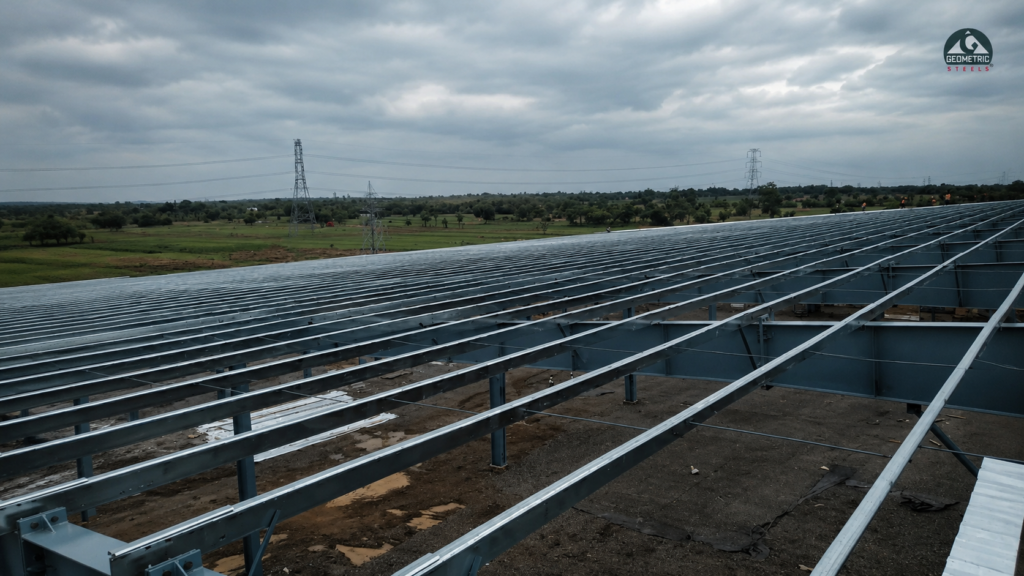
Z and C purlins are both cold-formed steel secondary structural members, and the choice between them is a structural engineering decision — not a matter of preference. The following is a general comparison; the correct choice for any specific project must be confirmed by the project’s structural engineer.
| Structural Factor | Z Purlin | C Purlin |
| Section symmetry | Point-symmetric (Z-shaped) | Axis-symmetric (channel-shaped) |
| Lapping at supports | Nests and overlaps efficiently — commonly used for continuous multi-span systems | Typically does not nest in the same way — often used in single-span or sleeved configurations |
| Typical span application | Multi-span continuous systems where lapping is used to enhance capacity | Single-span or shorter-span applications; also used with sleeve connections |
| Common in PEB roof/wall systems | Very common — widely specified for PEB secondary structure | Also common — selection depends on engineer’s design approach |
| Design guidance | Cold-formed steel design principles — refer to IS 801 and manufacturer load tables | Cold-formed steel design principles — refer to IS 801 and manufacturer load tables |
Note: This comparison is a general engineering reference only and should not be used as a substitute for project-specific structural design. The correct purlin type, section size, and lapping configuration for any project must be determined by the project’s structural engineer based on span, loading, deflection limits, and the applicable design code. Figures and characterisations above can vary according to project requirements, span configuration, and location.
The Web Height Range Question: Why 80mm Matters for Lighter Structures
Z purlins are manufactured across a range of web heights (also called section depth), typically starting at 100mm in the commonly available Indian market range and extending up to 300mm or beyond for larger-span applications. The web height, combined with flange width, steel thickness, and yield strength, determines the section’s bending and shear capacity for a given span and load.
For lighter secondary structures — canopies, small sheds, bagasse stores, or short-bay-spacing structures — the structural design calculation may indicate that a web height smaller than the commonly available 100mm minimum would be structurally adequate. In the absence of a smaller option in the market, structural engineers are often required to specify the next available size up, which can mean additional steel tonnage and cost without a corresponding structural benefit.
Geometric Steels manufactures Z purlins at an 80mm web height in addition to the standard range from 100mm to 300mm. This is intended to close that gap for lighter-structure applications where the full 100mm section is not structurally required.
| Web Height | Indicative Application Range | Availability |
| 80mm | Light secondary structures, canopies, smaller-span sheds — subject to structural design verification | Available from Geometric Steels; confirm availability with other suppliers |
| 100mm | Standard light industrial structures | Commonly available across the Indian market |
| 150mm | Medium-span structures — subject to structural design | Commonly available across the Indian market |
| 200mm | Larger-span structures — subject to structural design | Commonly available across the Indian market |
| 300mm | Long-span or heavy-load structures — subject to structural design | Available from most established manufacturers |
Note: Web height application ranges above are indicative and general in nature. The correct web height, flange width, thickness, and yield strength for any specific span and load must be determined by the project’s structural engineer using the manufacturer’s load-span tables. Availability of specific web heights from other manufacturers may vary — confirm directly with each supplier. All figures are subject to change according to client requirements, project location, and current production capability.
Geometric Steels does not claim exclusive ownership of the 80mm web height dimension as proprietary technology — it is a standard cold-formed section size that GS manufactures and makes available. The relevant point for a structural engineer is availability: confirm with any prospective supplier, including GS, whether the specific web height, thickness, and yield strength combination required by your design is available and can be manufactured to your programme.
Applicable Standards for Z Purlin Design and Manufacture in India
IS 801:1975 — Code of Practice for Use of Cold-Formed Light Gauge Steel Structural Members in General Building Construction
IS 801 is the primary Indian standard addressing the design of cold-formed steel structural members, including Z and C purlins. It provides the methodology for calculating effective section properties, allowable stresses, and deflection limits for light-gauge cold-formed sections. Any Z purlin load table provided by a manufacturer should be derived using IS 801 principles — or, where a manufacturer references an alternative code (such as AISI S100 or Eurocode 3 Part 1-3), this should be clearly stated so the structural engineer can assess equivalence for the project.
IS 811:2018 — Specification for Cold Formed Light Gauge Structural Steel Sections
IS 811 specifies the dimensional tolerances, section properties, and manufacturing requirements for cold-formed light gauge steel sections, including Z and C purlins. Compliance with IS 811 dimensional tolerances is a reasonable baseline expectation for any Indian Z purlin manufacturer.
IS 875 Part 1, Part 2, and Part 3 — Loads on Buildings and Structures
The design loading for any purlin system — dead load (Part 1), imposed/live load (Part 2), and wind load (Part 3) — must be established per IS 875 before purlin selection. Wind load is typically the governing case for purlin design in most Indian industrial buildings, particularly for roof purlins subject to wind uplift. The project’s structural engineer determines the applicable wind zone, terrain category, and building geometry factors per IS 875 Part 3:2015.
IS 277 — Galvanised Steel Sheets (Coating Specification)
Where Z purlins are supplied with a galvanised coating, IS 277 specifies the coating classes and corresponding coating mass. Confirm the coating class specified for your project — heavier coating classes provide greater corrosion resistance and are typically specified for coastal, high-humidity, or chemically aggressive environments.
Yield Strength Grades: 240 MPa and 350 MPa
Z purlins are commonly available in structural steel grades with yield strengths in the range of 240 MPa to 350 MPa, corresponding to IS 2062 or equivalent structural steel grade classifications for the base coil material. Higher yield strength material allows a lighter section (thinner gauge or smaller depth) to achieve the same structural capacity as a lower-grade section — but the design calculation, section properties, and connection design must all be verified for the specific grade used. Confirm the yield strength grade in the manufacturer’s material test certificate; do not assume a grade without documentation.
The Geometric Steels Z Purlin Range
Geometric Steels manufactures Z purlins at its Kurkumbh MIDC, Pune facility under ISO 9001:2015 quality management, accredited under the IAF Multilateral Recognition Arrangement. The following is a general overview of the range — specific section properties, load tables, and pricing are confirmed at the project quotation stage.
| Parameter | Geometric Steels Z Purlin |
| Web height range | 80mm to 300mm — confirm specific availability at enquiry stage |
| Yield strength | 240 MPa or 350 MPa — confirm at order stage with material test certificate |
| Coating | Hot-dip galvanised — coating class confirmed per project requirement (IS 277) |
| Custom lengths | Mill-cut to specified length — standard capability up to 12m; longer lengths on request, subject to confirmation |
| Lapping system | Standard nested lap detail for continuous multi-span systems — confirm detail with structural engineer |
| Load-span data | Available on request for specific section, grade, and span configuration — for structural engineer verification |
| Quality certification | ISO 9001:2015 (IAF MLA accredited) |
| International compliance | CE marking held across applicable GS products — confirm applicability for purlins per project |
| Material traceability | Material test certificates available per coil batch from primary steel producers |
Note: The parameters listed above describe the general capability of the Geometric Steels Z purlin manufacturing range. Specific web heights, yield strengths, coating classes, and lengths available for a given project are confirmed at the quotation stage and are subject to change based on client requirements, structural design, project location, and current manufacturing capacity. Structural load capacities must always be independently verified by the project’s structural engineer and are not implied by this table.
What to Verify From Any Z Purlin Manufacturer Before Ordering
Whether you are evaluating Geometric Steels or any other Indian Z purlin manufacturer, the following checklist identifies the information a genuine manufacturer should be able to provide without hesitation.
- Load-span tables for the specific section, grade, and configuration you require — derived from IS 801 principles or a clearly stated equivalent code, not generic marketing figures.
- Material test certificates confirming the actual yield strength of the coil used — do not accept a verbal assurance of ‘350 MPa’ without documentation.
- Dimensional tolerance compliance with IS 811:2018 — ask for inspection records if this is a concern for your project.
- Coating class and coating mass compliance with IS 277 — confirm this matches your project’s corrosion resistance requirement, particularly for coastal or chemically aggressive environments.
- Confirmation of available web heights, thicknesses, and lengths — including whether your specific required combination is a standard product or requires custom manufacture, and the associated lead time.
- ISO 9001:2015 certification status and accreditation body — confirm whether the certifying body is IAF-accredited, which affects recognition for government and international tender purposes.
- CE marking status, if required for your project — not all Indian purlin manufacturers hold this; confirm applicability to purlins specifically, as CE marking scope varies by product category.
- Reference projects at a comparable scale to yours — a manufacturer with documented project experience at your scale is lower risk than one without.
This checklist applies equally whether you are evaluating Geometric Steels or any other manufacturer. A structural engineer or procurement head who verifies these eight items before order placement significantly reduces the risk of receiving a product that does not match the design intent.
Installation and Handling: Practical Considerations
Z purlins are generally straightforward to install using standard steel erection practices, but a few considerations affect both structural performance and installation efficiency.
Lap Length and Bolt Pattern
Where Z purlins are lapped at internal supports to create continuous beam action, the lap length and bolt pattern must follow the structural engineer’s design — typically based on the manufacturer’s recommended lap detail for the specific section and span. Incorrect lap length or bolt spacing can compromise the continuous beam action the lap is intended to achieve.
Mill-Cut Lengths and Site Waste
Specifying purlins mill-cut to the exact bay spacing required by the project — rather than standard stock lengths requiring site cutting — reduces material waste, reduces site labour, and ensures each section is manufactured to the design length. Confirm with your supplier whether mill-cut-to-length is a standard service or an additional-cost option.
Corrosion Protection at Site Cuts and Drilled Holes
Any site cutting or drilling of a galvanised purlin section exposes bare steel at the cut or hole edge, creating a potential corrosion initiation point. Cold galvanising compound or an equivalent touch-up coating should be applied to any site-modified edge per the coating manufacturer’s recommendation and project specification.
Handling and Storage Before Installation
Purlins should be stored off the ground, protected from prolonged standing water, and stacked in a manner that avoids point-load distortion of the section. Extended site storage in poor conditions before installation can affect coating performance and section straightness — confirm your site’s storage plan is appropriate for the delivery schedule.
Frequently Asked Questions
Q1: What is the difference between a Z purlin and a C purlin, and which should I specify?
The choice between Z and C purlin sections is a structural engineering decision based on span configuration, lapping requirements, and the overall structural design approach for the project. Z purlins are commonly used where continuous multi-span action through lapping at supports is part of the design. C purlins are also widely used, including in single-span or sleeved configurations. Neither section is universally superior — the correct choice depends on your project’s specific structural design, and should be confirmed by your structural engineer, not selected by convention alone.
Q2: Does Geometric Steels manufacture Z purlins at 80mm web height, and is this available from other manufacturers too?
Yes, Geometric Steels manufactures Z purlins at an 80mm web height, in addition to the more commonly available 100mm to 300mm range. We are not aware of this specific web height being widely available in the Indian market at the time of writing, but availability across the market can change, and we encourage you to confirm current availability directly with any manufacturer you are evaluating, including us. We do not claim this dimension as patented or exclusive technology — it is a standard cold-formed section size within our manufacturing capability.
Q3: What yield strength should I specify for a Z purlin — 240 MPa or 350 MPa?
The required yield strength is determined by your structural engineer’s design calculation, based on the span, spacing, and loading for your specific project. Higher yield strength (350 MPa) may allow a lighter section to achieve the same structural capacity as a heavier 240 MPa section, which can reduce steel tonnage and cost — but this must be verified through proper structural design, not assumed. Always request a material test certificate confirming the actual yield strength of the coil used in your order.
Q4: Can Geometric Steels provide load-span tables for Z purlins?
Yes. Load-span data for specific sections, grades, and span configurations is available on request. This data should be used by your structural engineer as an input to the overall structural design and verified against the applicable design code and your project’s specific loading conditions. We recommend requesting this data early in the design process rather than after the purlin size has already been assumed.
Q5: What is the lead time for a custom Z purlin order?
Lead time depends on the section size, quantity, coating specification, and current production schedule. Standard sections in commonly ordered sizes typically have shorter lead times than custom web heights or non-standard lengths. Confirm your required delivery date and quantity at the enquiry stage, and we will confirm feasibility and lead time as part of the quotation.
Q6: Does Geometric Steels supply Z purlins for government, PSU, or infrastructure projects?
Yes. Geometric Steels holds ISO 9001:2015 certification accredited under the IAF Multilateral Recognition Arrangement, which is recognised for most government and PSU vendor approval processes. For projects requiring CE marking or specific compliance documentation, confirm the applicable requirement at the enquiry stage so it can be addressed in the quotation and supply documentation. Geometric Steels has supplied structural and building envelope products for infrastructure projects including Samruddhi Mahamarg and the Z-Morh Tunnel — contact us for details relevant to your project type.
Request Load-Span Data and a Project-Specific Quotation
Send us your bay spacing, span configuration, roof pitch, and applicable wind zone, and we will confirm the available web height, grade, and coating options for your project, along with load-span data for your structural engineer to verify. No assumptions, no unverifiable numbers — just the information you need to make a sound structural decision.
Every Z purlin enquiry to Geometric Steels receives:
- Confirmation of available web height, thickness, and yield strength options for your application
- Load-span data for your structural engineer’s verification
- Material test certificates from primary steel producers
- ISO 9001:2015 (IAF MLA) certification documentation
- CE marking documentation, where applicable to your project
- Mill-cut-to-length quotation to reduce site waste and installation time
- Project-specific pricing and delivery schedule confirmed against your programme
For More visit here! https://geometricsteels.com/structural-purlins/
Contact Geometric Steels Roll Forming Pvt. Ltd.
Phone: +91 8550995556 | geometricsteels.com
Manufacturing: Kurkumbh MIDC, Pune, Maharashtra
Supplying structural, roofing, ventilation, and decking products across India and 7 export countries
ISO 9001:2015 (IAF MLA) | CE Marked (applicable products) | Established 2006
India Builds Under Our Roof. | 20 Years · 64 Products · 7 Countries · ISO · CE · IAF Certified